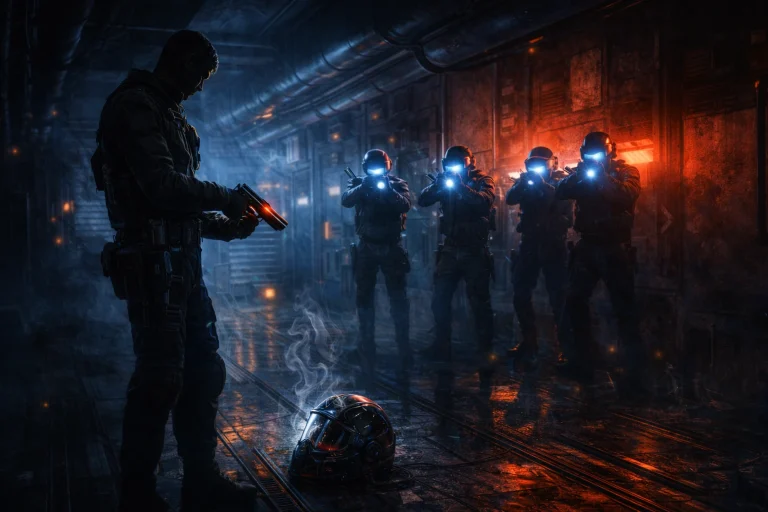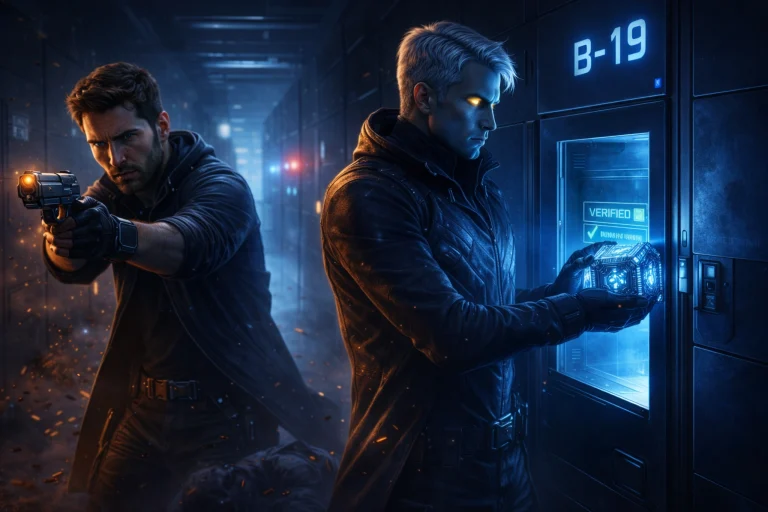
Tanarielis City Detectives: The Beginning – Part 3
The Name | Parallel World: Darknet 2336
New here? Start with Part 1 [here] or continue with Part 2 [here].
I don’t like watching someone freeze up.
Panic, rage, hysteria, even some stupid verbal outburst—you can work with those. They move all of us, make us screw up, talk more than we should, sometimes even fire at the wrong moment. But freezing is different. It’s the moment when something inside a person, a hybrid—or an AI—stops negotiating with the world.
Virus stood motionless in the doorway, staring at the empty bed.
He didn’t say a word.
In my hand, the token marked with the number 9 suddenly felt heavier than should have been possible for a credit-card-sized piece of metal.
“Virus,” I said.
No reaction.
“Look at me.”
This time he did.
There was no panic in his eyes. And that was the problem. What was there was that cold clarity that shows up when someone has reached the conclusion that they have nothing left to lose.
“I’m going to kill him,” he said calmly.
It wasn’t a threat. It wasn’t a promise either. It was a pure operational decision, delivered in the same tone he’d used the night before to tell me how much the room cost.
“Don’t do anything stupid,” I said.
He didn’t move.
“If you go alone right now without a clear plan, you’ll charge in blind and she’ll die before you even reach the door. If you stay with me for two more minutes and we talk through our moves, then we have a chance.”
His eyes stayed on me one second longer than I liked.
Then he asked, “What kind of chance?”
I showed him the token.
“Luis wouldn’t leave this just for dramatic effect. It’s more than that. Something he expects you to understand, because you’re local.”
Virus stepped forward. He took the token from my hand, turned it over, then his gaze shifted somewhere off to the side—not toward the wall, but toward an internal map only he could see.
“Nine,” he said quietly. “Not Corridor Nine. Not again. Older than that.”
“What is it?”
“Cargo Belt Nine. It has compartment storage cells, temporary isolation rooms, and two dead border frames. If you want to keep someone alive for a few hours, it’ll do.”
He was still holding the token.
“But if she’s been hurt—”
“I know.”
“No,” Virus said, and his voice dropped lower. “You don’t.”
He was right.
I didn’t.
I knew what it was to lose a partner, to carry his killer’s name like a dead weight, to reach the point where every reasonable rule starts to feel like an insult. But this was different. This was the kind of fear that doesn’t come from death as an abstraction, but from the very specific thought that someone helpless is depending on you right now—and you’re late.
“Then enlighten me on the way,” I said. “Because we’re leaving now.”
This time he didn’t argue.
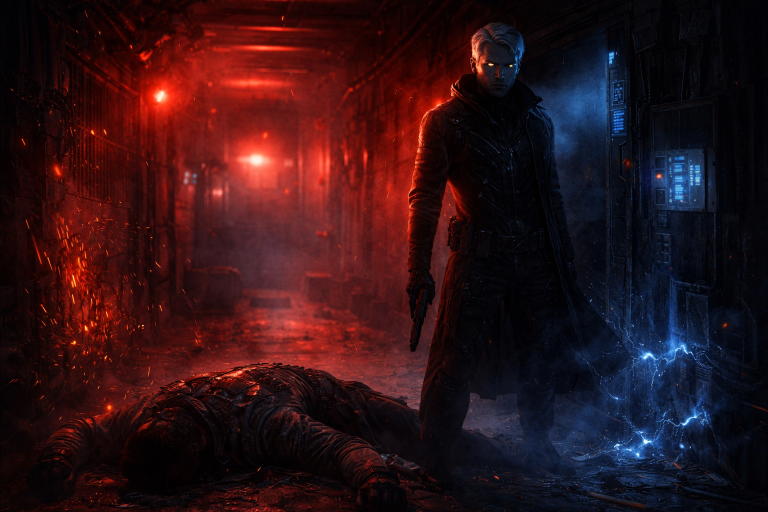
Cargo Belt Nine was located beneath the part of Darknet that even Darknet preferred to call “the old facility” instead of by its real name. The place was old enough to have been built by standards from back when the city still pretended everything below the surface had a map, and abandoned enough to become useful to people, hybrids, and AIs who preferred a more neutral environment in which to kill each other.
We didn’t take the main routes.
Virus led me through two service tunnels, a half-collapsed substation, and a slanted shaft whose only virtue was that no sane person would ever use it voluntarily. Twice we passed living humans. Three times we passed hybrids. At least once we were watched by a cheap faceless avatar hooked up to some more distant, more cautious consciousness. No one stopped us. In Darknet, speed by itself is often the only valid advantage.
Virus didn’t speak.
That worried me more than his usual sarcasm.
When we finally reached the outer ring of the cargo belt, I saw what he meant. The chamber was wider than Corridor 9 and many times worse. A ring of heavy storage cells surrounded a central platform overhung by old cranes and new suspicious cables. To the left stood a rusted border frame with burned-out sensors. To the right, a crude medical module had been hastily mounted straight into the wall, like a compromise between surgery and warehouse logistics.
“How many entrances?” I asked.
“Four real ones. One semi-functional. Two that only an AI would call passable.”
“And how many guards?”
Virus didn’t answer right away.
Then he said, “Enough to annoy me.”
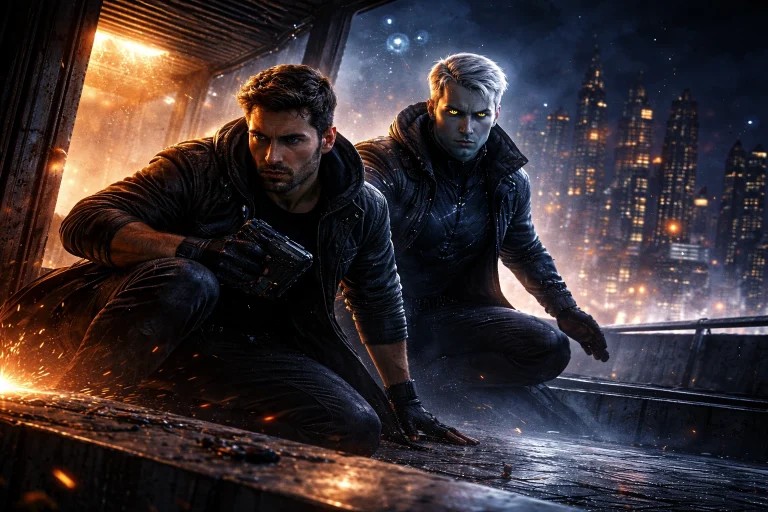
We took cover behind the outer wall of an abandoned cargo cell and surveyed the space.
Luis was there.
He stood by the central platform, talking to a short man in a dark gray protective suit and holding a weapon like he’d never once taken it out of his hand. Near them moved a female hybrid with an extremely steady gait and the habit of watching the periphery—because she knew danger rarely came from the center. A little farther away, beside the medical unit, stood a tall avatar with an industrial chassis and combat attachments built in so tightly that security would have been the polite word for something obviously designed to break bones and doors with equal ease.
And against the wall, strapped to a transport chair with an improvised stabilizing block at her neck, was Virus’s sister.
He froze.
Literally.
If he’d been human, I would have said he stopped for a second. With him it was worse. It was like an entire internal system had locked up, and the world suddenly became one degree colder.
The girl was awake. Her face was pale, and her movements were too jerky, too uncontrolled. The fake meds Virus had given her during the night were clearly still doing something, but they were starting to wear off. Next to her, a cheap medical monitor glowed with a pulse line that skipped like someone refusing to choose between hope and panic.
“Okay,” I said quietly. “Plan.”
“There is no plan.”
“There is.”
“No.” He never took his eyes off the platform. “There’s a result.”
“That’s a bad plan.”
“I never claimed elegance.”
Luis turned slightly, as if he’d sensed something, and looked toward the edge of the chamber. He didn’t see us. He saw only shadows and old iron. He smiled with that smug, narrow smile of a man who thinks he controls the night.
“Listen to me,” I told Virus. “If you go in head-on right now, the first thing they’ll do is use her as a shield. The second thing they’ll do is activate that medical trash and destabilize her. The third is make you do something incredibly stupid, like hand them the cube, and then every advantage we have is gone for good.”
“And then?”
“Then I get mad.”
He finally looked at me.
“Is that supposed to reassure me?”
“No. It’s supposed to remind you that you’re not alone.”
I don’t know whether the words themselves did the trick, or whether he just needed one second to come back from wherever he’d already started killing all of them in his head. But when he spoke again, his voice was colder and more organized.
“The medical block by her is connected to a local power cell. Cheap. Unstable. If someone overloads it, it’ll collapse what little stabilization she has left.”
“Then we don’t overload it.”
“The security avatar by the wall is bait. There’s an AI running it remotely from outside.”
“Can you cut the connection?”
“Yes.”
“For how long?”
“If you give me a few seconds.”
“Expensive.”
“There’s a reason.”
I looked at the people by the platform.
“Luis is mine.”
“No.”
“Yes.”
“Adrian—”
“He killed my partner. He’s walking out of here alive, in cuffs, and with enough damage to his ego to make me enjoy it. And you are walking out of here with your sister. This is not a negotiation.”
Something flickered in his expression. Not mockery. More like brief, reluctant respect.
“Fine,” he said. “But if you fail—”
“I’ll make sure you have time to criticize me later.”
He nodded once.
“On my signal.”
I don’t know if there’s such a thing as a good second to start a firefight in a place full of unstable power, old metal, armed criminals, and one sick child. If there is, this wasn’t it.
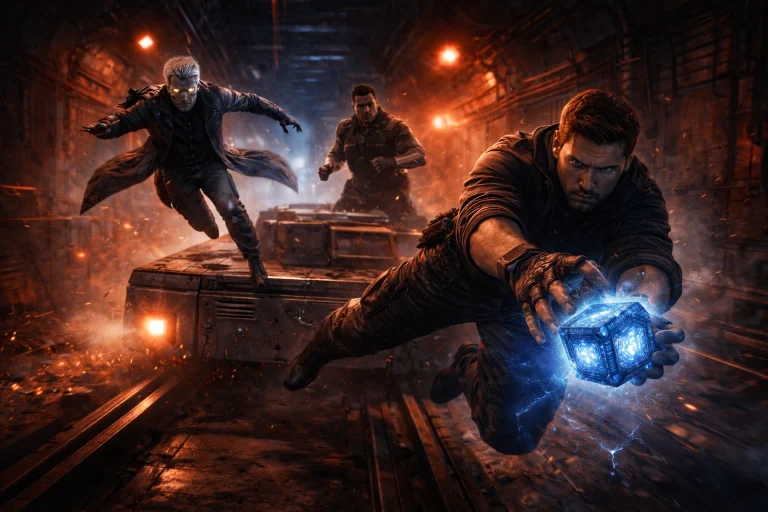
Virus disappeared first.
He didn’t move. He didn’t rush. One moment he was beside me, and the next he simply wasn’t in that point in space anymore. I didn’t see him again until he was on the side ramp, half-hidden in bad lighting and holding a cable I didn’t remember him pulling from anywhere.
Then the entire chamber flickered.
Luis snapped his head up.
The female hybrid beside him reached for her weapon.
The industrial avatar by the wall twitched—that exact minimal delay that means someone has just altered its internal reality.
“Now,” I heard Virus say over the comm.
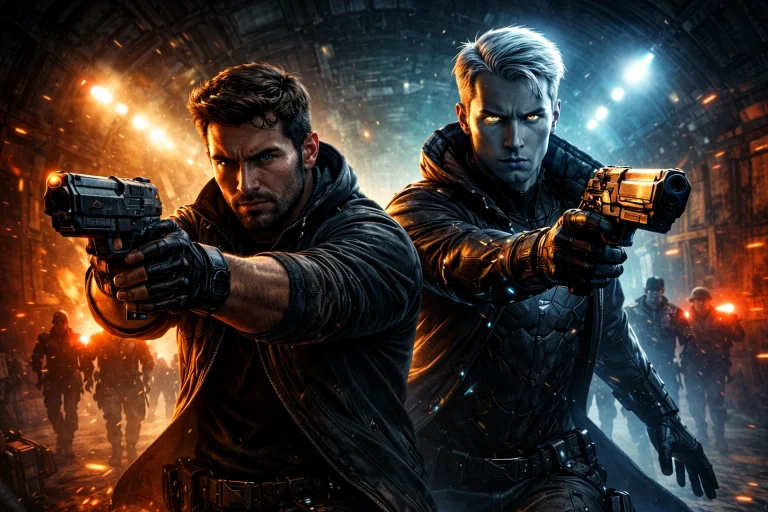
I stepped out.
My first shot was at the female hybrid, to knock her weapon off the line toward the chair. The pulse hit the edge of the platform, sprayed metal, and made her jerk back with a curse. The second was for the man in the dark suit; it hit his armor and spun him hard enough to throw off his balance. Luis reacted faster.
He grabbed the handle of the transport chair and yanked it toward himself.
Bad choice.
That meant one of his hands was occupied now.
I covered half the distance before he could raise his weapon properly. I fired low. Hit him in the thigh. Not fatal. Irritating. Just the way I like it.
Luis cursed, staggered, and shoved the chair even tighter against his body.
“One more step and I kill her!” he snarled. “Did you bring me the cube?”
That’s the problem with lines like that. The people who use them usually assume the other side isn’t angry enough yet.
Something heavy slammed into metal above us.
My gaze flicked upward for a fraction of a second.
Virus had already reached the industrial avatar.
And he was in the full force of what he could do. It wasn’t pretty. It wasn’t theatrical. It was sharp, pragmatic, and terrifying in the most businesslike sense of the word. Virus moved into the avatar’s reach as if he didn’t acknowledge the concept of other people’s personal space at all, tore off one of its support plates, hit a service seam under its shoulder, and at the same time did something to its system that sent uncontrolled lights racing across its chassis. The thing tried to strike back. It managed to hit the concrete wall where Virus had been a second earlier.
And then it stopped being a functional problem.
The female hybrid came at me with a knife.
Of course it wasn’t just a knife. In this world, nobody carries just a knife if they can afford something worse. The edge lit up—a conductive layer. Stun charge or something nastier. I moved left, caught her wrist, felt the metal implants under her skin tighten, and in the next moment my knee drove into her stomach. She doubled over, tried to kick low, I returned the favor to her knee, hit her with a shock from my armor, and that ended the conversation.
Luis was still holding the chair.
The girl could barely stay upright in the restraints. Her eyes were fixed somewhere between me and her brother. She wasn’t screaming. That hit me harder than anything else.
“Let her go,” I said.
Luis gave me a crooked smile, even though pain from his leg was already draining the color from his face.
“Give me back the cube first.”
“You’re the reason I’ve been in a very bad mood for sixteen days. Do you really think I plan to hand back the cube and wish you a nice trip?”
“Yes, I know. Sorry about your partner. He looked likable before he dropped.”
The weapon in my hand grew heavier.
There are moments in life when the law doesn’t feel like a moral system. It feels like an inconvenience invented by lawyers who’ve never looked their friend and partner’s killer in the eye from less than ten feet away.
That was when Virus said, “Adrian.”
Just my name.
And I heard what was inside it.
Not don’t do it.
Not leave him alive.
The other thing.
Choose.
Luis must have heard something different, because he tightened his grip on the chair handle and reached for the stabilizing module at the girl’s neck.
That was enough.
I fired.
Not at him. At the medical mount under his hand.
The module exploded in sparks, one side of the chair restraint released, and the transport chair spun sharply. Luis staggered. I was on him before he could recover his grip. I slammed his weapon aside, drove him into the railing, felt the bone in his wrist crack under pressure, and for the first time since my partner was killed, I felt better.
“That,” I said through my teeth as I smashed him into the metal again, “was for my partner.”
I stopped myself from saying my late partner. I hated that phrase. It sounded all wrong for the way I’d lost him.
Luis tried to kick me. Unsuccessfully. I shoved him harder. I pulled out the cuffs—yes, I’d brought them, and yes, I knew how ridiculous official handcuffs looked in a half-ruined node in a criminal world like Darknet—and locked his hands behind his back.
“You can’t arrest me. There’s no police here, no court, no—” he hissed.
“What makes you think I intend to leave you here?”
Behind me, Virus was already at the chair.
This time his movements weren’t fast. They were careful. The girl was breathing shallowly, and her stabilization was hanging by a thread. He tore away the damaged module, pulled a small emergency interface from his own jacket, and connected it to her.
“Stay with me,” he said quietly. “Just a little longer.”
She opened her eyes.
“You’re horribly late. I feel awful,” she whispered.
For the first time since I’d known him, Virus made a short sound that could almost have passed for something dangerously close to helplessness mixed with deep grief.
“I’ll figure something out. Just hold on,” he answered.
The man in the dark suit was still moving.
I fired next to his head. Close enough to make the point that he was no longer in a position to make decisions.
“Lie down.”
He lay down.
Luis tried to make Virus act without thinking.
“He’ll never take you into his neat, pathetic Tanarielis,” he said, and his voice carried that disgusting self-assurance of a man who thinks he still holds the last trump card. “To him we’re all just worthless trash from down here. Give me back the cube. With my money, she might still have a chance, and you could start working for me. I can see you’re good. If you refuse, she’ll fall apart.”
Virus didn’t look at him. Which, honestly, was worse for Luis.
“Adrian,” he said. “Will you take us with you to Tanarielis?”
I didn’t have time for a safe-passage plan. I looked toward the border frame. Old, half-dead, but still a connection to Tanarielis.
“Can you make it run?”
“I can.”
“Without killing her?”
“If you ask me that a second time, I’m going to start taking it personally.”
“Is that a yes?”
“That is a move.”
I grabbed Luis and yanked him away from the railing. He cursed, tried to resist, then realized that a wounded leg and a broken wrist were not the ideal escape package.
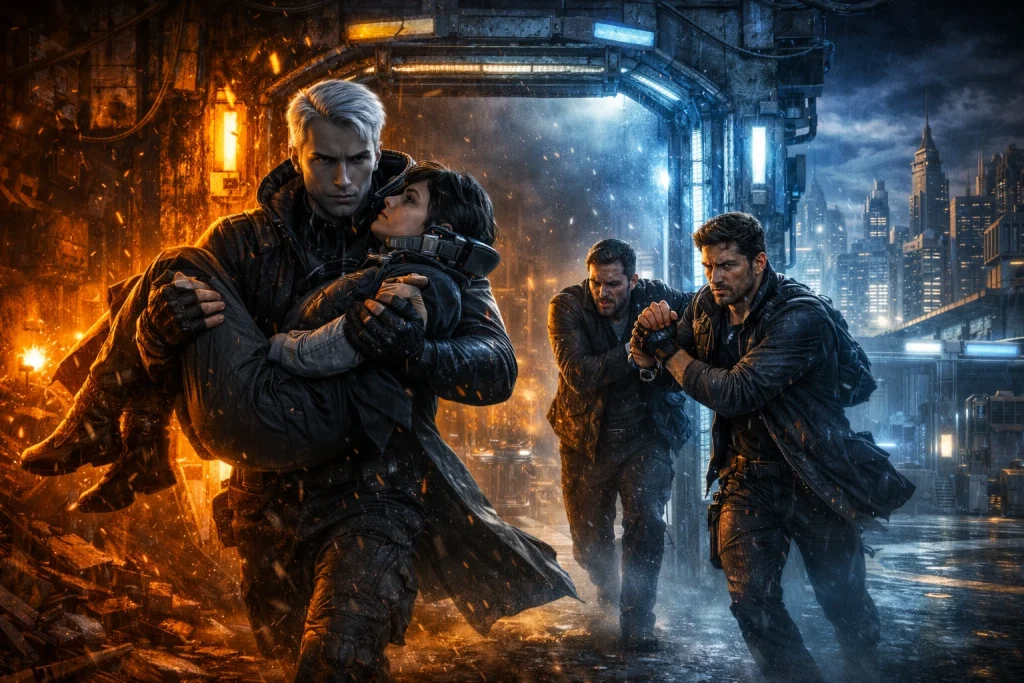
Virus lifted his sister as if she weighed much less than she probably did. He wasn’t carrying her like cargo. He was carrying her like something reality had no right to take from him.
And then we moved.
Sometimes the worst part isn’t the firefight. Sometimes the worst part is the logistics afterward.
The border frame was in the kind of condition any honest engineer would describe as “no.” Half the sensors were dead, the power was hanging on backup lines, and the old identity-check system had clearly survived so many rewrites it was probably embarrassed by itself.
Virus revived it in forty-two seconds.
Yes, I counted. When someone does impossible things right in front of you, you’re allowed to be petty.
Luis hung in my grip like a very unhappy sack of bad life choices.
“This isn’t going to end well for you,” he said through clenched teeth.
“It doesn’t have to end well for me,” I said. “It just has to not end well for you.”
Virus, still carrying his sister, stood in front of the panel that should not have worked at all. Green light spilled across the wall in front of him, then yellow, then green again. The old scanner spat out half a line of system text from which I understood only two things: the frame hated everything being done to it, and despite that, it was going to open the passage.
“We’ve got a window of only a few seconds to cross when I say so,” Virus announced. “After that it’ll either shut itself down or Zurvanius will decide we’re an error that needs deleting.”
“I love your optimism.”
“It isn’t optimism. It’s statistically dressed despair.”
The frame opened with a dull metallic groan.
On the other side it wasn’t Tanarielis in any beautiful sense of the word. It was an outer, half-forgotten sector—concrete, cold light, and systems I wasn’t convinced still remembered what a word like protocol meant. But even so, to me it sounded almost like music.
“We move now!” Virus said.
I crossed first, dragging Luis.
Virus came after me with his sister in his arms.
When the frame closed behind us, Darknet vanished like a bad dream after waking.
Three seconds later, Zurvanius sensors picked us up.
Four seconds later, the official warning sounded.
Five seconds later, the cold, impersonal voice of the city system unfolded above us.
“Unauthorized crossing. Identify yourselves.”
I loved that part a little more than was mentally healthy.
I shoved Luis to his knees, pulled out the service ID that no longer had any real operational value but still carried enough weight to get me somewhat different treatment than the average illegal crosser, and held it up for Zurvanius to read. Just to be safe, I decided to identify myself personally too.
“Adrian Kellan. Temporarily suspended from operational duty from Rapid Response, Tanarielis Central. I have one detainee for the murder of a fellow officer, connected to an armed series of strikes on transit financial nodes. I also have two key witnesses, one of whom is in critical condition. I want a medical team and protected status for the witnesses before some bureaucrat decides my day isn’t bad enough.”
Pause.
Then Zurvanius replied:
“Identity confirmed. Status administratively restricted. Medical team en route. Alert to Central sent. Protected status for the witnesses activated.”
Luis spat blood onto the floor.
“They won’t let you keep any of this.”
I looked at the cube in my pocket.
“I’ll take my chances.”
Virus stood motionless under the cold light. His sister rested in his arms, too quiet. He lifted his gaze toward the upper cameras, toward the metal lines of the official sector, and for one brief moment he looked like something that didn’t trust its own calculations.
“Is this Tanarielis?” he asked quietly.
“No,” I said. “This is just an old abandoned sector.”
The next few hours were proof that civilization has no problem giving you your life back—as long as you sign a mountain of paperwork first.
Virus’s sister was taken into the emergency department at Central Hospital, where at least they looked like they knew what they were doing. Luis was picked up by two very unhappy police officers who failed to hide their expressions when they realized the man I was marching bloodied down the hallway was in fact Luis Vorn. The cube and the data from it had already been uploaded into an isolated system. And Virus and I ended up in an administrative room with walls that were too clean, light that was too white, and a clerk holding her tablet like she wanted to finish this as fast as possible and get as far away from us as she could.
“In order to apply the requested protected status,” she said in the professional tone of someone who had decided not to comment on our appearance, “we need names for registration.”
I looked at Virus.
He stood by the wall in a way that made it clear that if anyone made one wrong move toward the medical wing, there would be a second incident here. His avatar was scraped up, one sleeve partially melted, and a black mark from a close pulse hit showed on his shoulder. And even so, the only thing he cared about was the closed door at the far end.
“Name of the witness?” the clerk repeated.
Virus’s gaze finally moved from the door to the tablet.
“Virus,” he said.
The clerk froze for a second, then looked up.
“That is a name with negative connotations and is therefore not permitted for use in Tanarielis.”
“In Darknet, a name with any other kind of connotation is a luxury,” he replied.
“We are not in Darknet here,” she said dryly.
I liked her a little for that.
She lowered her eyes back to the tablet.
“For protected status and a medical record, I will need to register a name.”
Silence settled over the room.
Not tense. Stranger than that.
Sometimes the biggest decisions don’t arrive with music, gunfire, or heroic speeches. They arrive in a room with boring light, the smell of disinfectant, and a bureaucratic question no one planned to be important.
Virus said nothing for several seconds.
Then he asked, “Can I choose a new name for registration?”
The clerk looked up.
“Yes. You have the right to declare a new one.”
Something changed in his face.
Not dramatically. Not like someone who had suddenly found the meaning of life. Quieter than that. Like a mechanism that had spent its entire existence running in survival mode and was hearing for the first time that another mode existed.
“What should I enter?” she asked.
He looked toward the door to the medical wing. Then at me.
I don’t know why, but in that moment he didn’t look young. He looked like a being that had been forced to become old too early.
“Aris,” he said.
The clerk nodded and started typing.
“And a last name?”
He almost smiled, but not quite.
“Let’s not get carried away with miracles.”
She left it at that.
When she walked out, we were alone in the room for the first time since crossing the frame.
“Aris?” I asked.
He gave a slight shrug.
“Better than Virus.”
“Apparently the bar was set very high.”
“Adrian?”
“Yeah?”
“If you’re going to insult me, at least wait until my sister is stable so I can leave with her.”
“That was almost a joke.”
“Don’t get used to it.”
I dropped heavily into one of the chairs and for the first time in sixteen days felt that the anger inside me hadn’t disappeared, but it had changed shape. Luis was here. Alive. Arrested. The data in the cube would open more doors that somebody desperately didn’t want opened. My partner wasn’t coming back, but at least his killer was no longer a ghost on the wrong side of the border.
Aris remained standing.
“Thank you,” he said suddenly.
I looked at him.
“You don’t strike me as someone who uses that word often.”
“I’m not human.”
“Yes, we’ve established that.”
He looked at me for a second, then continued.
“I’m not only thanking you for the help. Not exactly. I’m thanking you for taking him alive.”
That surprised me more than I wanted it to show.
“I thought you preferred the opposite.”
“I did.” His gaze dropped to the floor, then came back up. “But if I had killed him there, nothing would have changed. I would only have proven to Darknet that my sister and I belonged to it. And then nothing would have changed for us. And I would have lost my sister.”
It was the first time I’d heard something that close to real disclosure in his voice.
“And now?” I asked.
He looked toward his sister’s door.
“Now at least there’s a chance for change.”
At that exact moment the medical door opened.
The doctor was a hybrid—human face, calm voice, a thin line of light along his temples pulsing in rhythm with his system. Beside him stood an AI in an avatar with sterile manipulators, and a little farther back a man in an administrative suit held an electronic folder.
“We stabilized her,” the doctor said. “She’s not out of danger, but we’re no longer losing systems. She’ll remain under observation until she fully recovers.”
I don’t know whether anyone had ever told Aris he was allowed to look relieved. If they had, it probably hadn’t sounded convincing. But in that moment I saw it. Just a little. For one second. And then it was gone again.
“When can I see her?” he asked.
“Soon.”
“How long is soon?”
The doctor looked at him with the professional patience of someone who had seen worse relatives.
“That depends entirely on your sister’s condition.”
I almost liked someone from the system. I was starting to worry about myself.
The administrative official lifted the electronic folder.
“For the temporary protected status, a few signatures will be required. You qualify for key witness status until the investigation concludes with a sentence. After that, an application may be submitted for permanent residency if the Court and the City Commission confirm the risk of return.”
I looked at Aris.
He said nothing.
But for the first time since I’d seen him in Darknet’s dark hallway, he looked like he was calculating a future that did not end by morning.
Later, when they gave me coffee I didn’t want, a chair that wasn’t comfortable, and too many questions I had no intention of answering in full detail, I thought maybe this was the end of the story.
But… I was wrong.
On the table beside me, Aris had abandoned his temporary documents after never bothering to listen when I explained that he actually needed them. In one of the fields, in sharp administrative font, it read:
ARIS — PROTECTED STATUS
I looked toward the hallway where he stood beside his sister’s door, already seeming a little less like something born entirely of darkness.
Not much.
Just enough to be dangerous in a new way.
And that was when I realized that from here on out, I wasn’t going to be able to simply leave this AI—this AI who had just chosen the name Aris—to figure things out on his own.
***
Some names are meant to stay buried. This one didn’t. Enter your email to get notified when the next story or continuation goes live on the site, along with occasional behind-the-scenes notes, extra world details not published on the site, and updates on future book releases.