Tanarielis City Detectives: False Point of Origin — Part 1
Tanarielis City, 2347

When a man in a service uniform is running through the glass back of a house worth more than everything I had ever earned, lost, and still owed put together, there are only two important questions.
The first is how and why he ended up here.
The second is whether I’ll reach him before someone more expensive than me decides they don’t need him alive anymore.
“Left after the winter garden,” Aris said in my earpiece in that calm tone of his that always made me wonder whether he even understood the concept of bad timing or just considered it inefficient. “The service passage ahead of you is about to lock unless I intervene.”
“Then intervene,” I growled, vaulting over the low decorative channel some architect had decided made the rich man’s house look more refined.
The sole of my shoe slipped on the damp edge of the glass. For a second I saw three floors down below me—lights, water, plants, and enough open space to make it perfectly clear that if I fell, I’d turn into a short and unpleasant administrative procedure.
The man ahead of me was no amateur. He was fast, not wasting time on panic, and he used the house like he knew it well. He didn’t hesitate at splits in the corridor. He didn’t slam into automatic doors. He never looked back. Which left two possibilities—either he’d been here before, or someone was feeding him the route in real time.
I didn’t like either one.
The glass door at the end of the bridge sealed shut the exact second I reached it.
Then it lit red.
“Aris.”
“Already on it.”
The panel beside the frame crackled. The red blinked, shifted to yellow, and the door slid aside slowly enough to remind me how easy it would be to die because of someone else’s architectural vanity.
I made it through and caught the smell of ozone a second before the first small drone burst out from beneath the decorative arch above me.
“Of course,” I said. “Why just chase a man when we can do it with flying landscaping hardware too?”
The drone was about the size of a plate, matte black, and fast enough not to be a standard household model. Two thin cutting blades snapped open at the front. I had no intention of finding out what exactly they’d tested those on.
I fired at it on the move.
The shot spun it, but didn’t bring it down. A second drone was already coming in from the right.
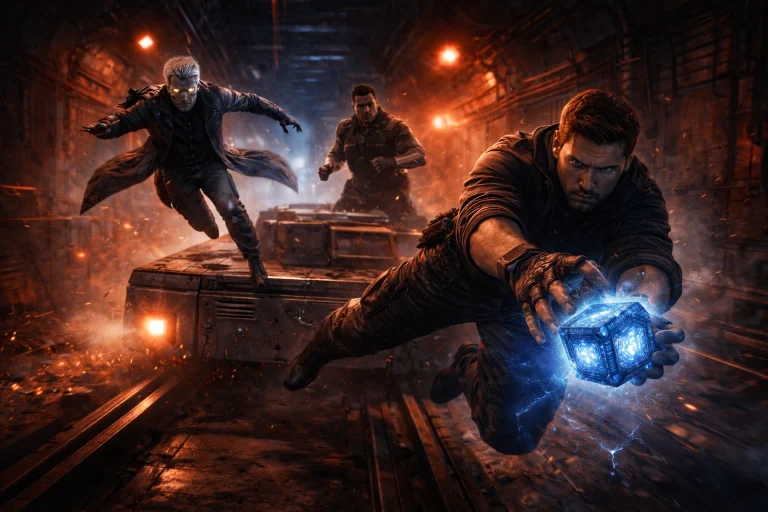
Somewhere behind me Aris stepped out from a side corridor with that infuriating calm of something that could afford not to breathe. He raised one hand and the air between us and the drones filled with short pulses of interference. The first drone twitched, lost stability, and buried itself in the living wall of plants. The second made a desperate attempt to compensate and shattered across the polished floor in bright, expensive pieces.
“Those were unauthorized devices inside a protected property,” Aris observed. “Which technically means this is no longer a standard bug sweep.”
“Thanks. Never would’ve figured that out myself.”
The figure ahead of us shot through the narrow service opening at the end of the corridor. For a fraction of a second I saw enough—dark gray maintenance gear, a light shoulder pack, a face filter, a fake service badge on the left side of his chest. He didn’t look like an ordinary thief. He looked like a man paid to get in unnoticed and leave without conversation.
“Fake,” Aris said before I could ask. “No registered service tech in the local access logs. His credential was injected through an external admin layer.”
“Translation: someone let him in.”
“Or someone never logged him out.”
That was the worse version, so naturally it was the one that sounded most believable.
I went through the service opening and onto a narrow maintenance catwalk that wrapped around the outer dome of the house. The night air of Tanarielis hit me full in the face—cold wind, distant traffic, light haze, and that constant feeling that the city looked its best exactly when someone was trying to kill you.
The man was thirty yards ahead and already running the outer edge toward the rooftop platform. Below, the brightly lit courtyard spread out in a geometric garden I didn’t bother appreciating, because I had more urgent things to do than evaluate someone else’s taste.
“He’s not running for an exit,” Aris said. “He’s running toward an extraction point.”
“Was that supposed to surprise me?”
“No. I just thought it might be useful for you to know.”
Two more machines detached from the wall on my right—this time not drones, but small exterior maintenance units. Except someone had given them an assignment that definitely didn’t come with the warranty. One of them fired a sticky stream at my legs. I jumped back, and the adhesive streaked across the metal edge and hardened instantly.
“I’m starting to like rich people less and less,” I said.
“That is not a new development.”
Aris wasn’t running after me. He didn’t need to. One part of him was in the avatar behind me, another was already chewing through the local house automation, and a third was probably doing something else that would save my life without explaining how. We had reached a workable version of partnership a long time ago: I didn’t question him about every minor detail, and he didn’t let me die of “incompetent design.”
I hit the rooftop platform just as the runner activated the outer rail and part of it folded open toward a service shaft beyond the perimeter. Smart move. Fast. Prepared. Clean.
I might’ve admired it if I hadn’t needed to shoot him to keep him from getting away.
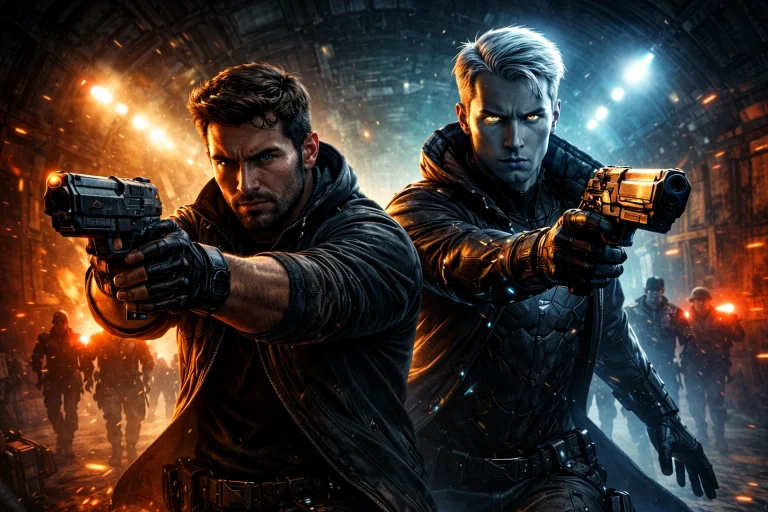
He turned on the move and pulled a compact weapon that didn’t look like anything licensed to a civilian technician. I caught the brief flash of the pulse and threw myself sideways. The shot sliced through the air exactly where my head had been a second earlier and melted the edge of a white decorative sculpture that almost certainly had its own separate tax paperwork.
I fired twice.
One shot tore a chunk out of the railing. The other made him dip a shoulder and lose half a step. It wasn’t enough.
He reached the opening to the service shaft, jumped onto the narrow outer edge, and then a short beam flashed through the night.
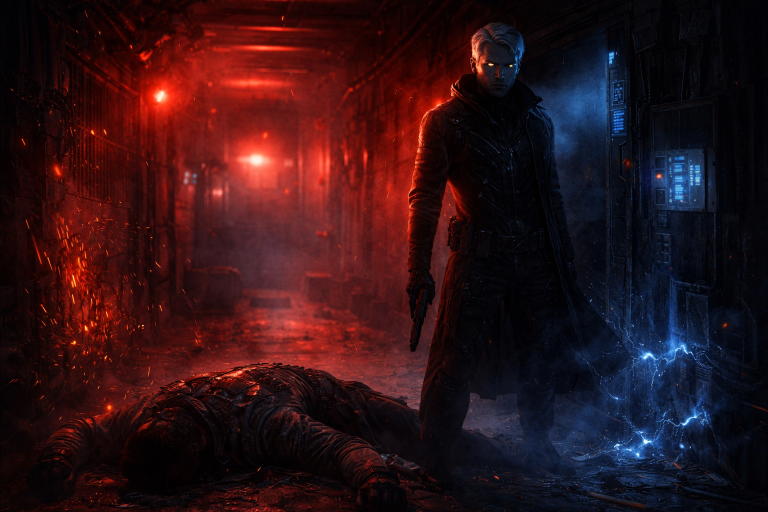
Not bright. Not dramatic. Just a brief, precise stitch of light that cut the darkness and punched into the base of his neck.
His body stopped cold.
Then it collapsed onto the railing, slid along it, and ended up hanging partway over the void in an ugly sprawl.
I froze for exactly as long as it takes a brain to process two things—that it wasn’t me, and that the next shot could very easily be.
“Down!” Aris said.
I didn’t make him repeat it.
I dropped behind the low lip of the platform just as the second flash hit the glass above me and spiderwebbed it with fractures.
“From where?” I asked.
“Long angle. They’re not holding a fixed line. The first shot was for the fake tech, not for us. The second is a polite suggestion not to argue with the decision.”
“I love polite people.”
Aris was beside me now. He dropped to one knee with that pointless human gesture he didn’t need but sometimes made for my benefit. Or to look more local, while not actually being local. Or because he enjoyed never giving me a completely certain answer to the question of what in him was habit and what was choice.
“The shooter is human. I can’t hack people. But the weapon is another matter,” he said. “And people like him rarely carry only one solution to a problem. If you want to check the body, this is your window. But don’t linger.”
I looked at the man hanging over the edge, then at him.
“This is not the moment to work on improving my judgment, is it?”
“No.”
I rolled over the lip to reach the body.
Dead. Or close enough that the difference had no practical value.
Inside the face filter, a dark chemical had already started spreading—something that would eat through whatever usable traces were left. There was a narrow container strapped to his shoulder. I ripped it free. Inside—not tools, not money, not a weapon. A thin matte module with several encapsulated cores laid out like a medical sample.
“Adrian,” Aris said. “Move. We need to get out of here.”
I shoved the module under my jacket and pulled myself back behind the lip just before a third shot scraped the metal where I’d been a moment earlier.
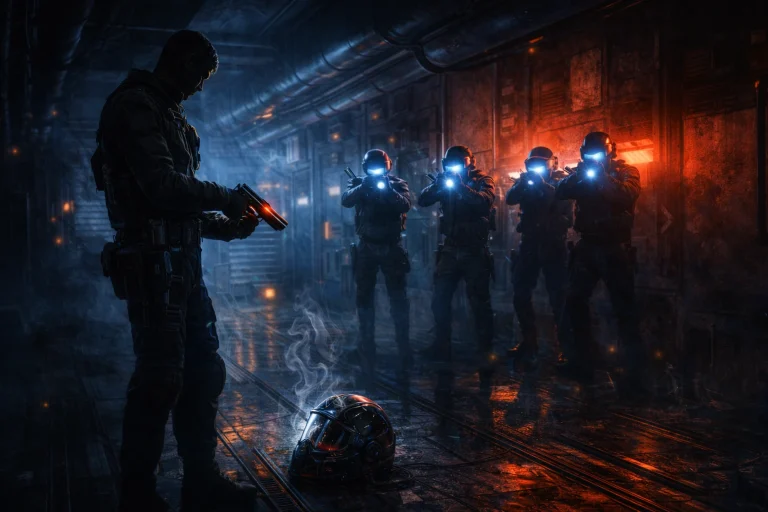
Then the roof shutters of the house slammed down with a heavy impact and cut off the line of fire.
“That you?” I asked, breathing hard.
“Yes. The owner will not be pleased.”
“Good. I’d have been upset if this night had gone by without pissing off at least one more person.”
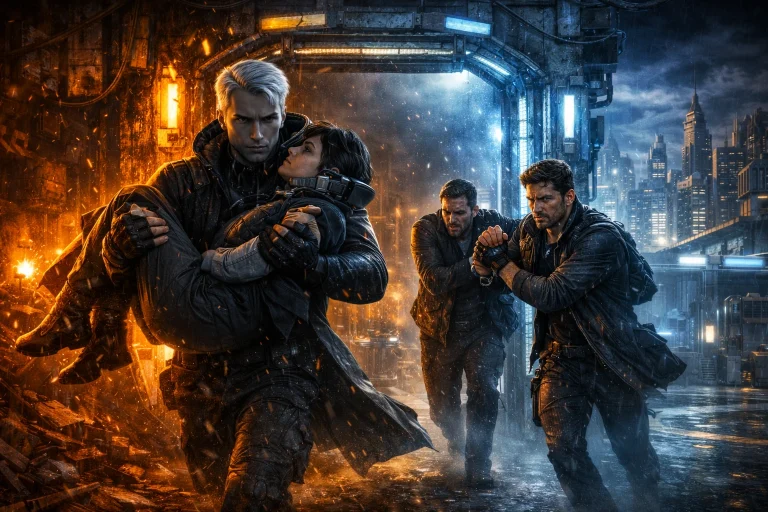
We got Merrow out of the panic room through a service route Aris had taken control of seconds before the local system decided it didn’t like us anymore. It wasn’t hard to convince the client to come with us. After shots get fired at your rooftop, even rich people understand that their home is no longer a home, just a set piece with bad habits.
“Central?” I asked as we went down a narrow emergency stairwell between walls that smelled like expensive filtered air and cheap panic.
“I filed a limited report,” Aris said. “Gunfire at the address. Unauthorized entry. One body on the roof. Enough that we won’t look like people who left a crime scene with excessive enthusiasm.”
“I’ve always appreciated your legal instincts.”
“That was not a legal instinct. That was hygiene. Our shooter will have a harder time following us now that the police are starting to sniff around.”
We came out through a loading ramp two levels below the main entrance. Vehsethin was waiting in the shadows, matte black and unfriendly enough not to ask questions it wouldn’t get the pleasure of hearing answered anyway.
Merrow got into the back with the tense silence of a man who still hadn’t decided whether he was angrier, more frightened, or simply too rich to be used to the idea that tonight he was prey.
We drove without headlights for the first two hundred yards.
“Do we have a tail?” I asked.
“So far, one curious camera, two private watchers, and a drone pretending not to follow us.”
“And in reality?”
“In reality, they’re not following us anymore.”
I didn’t ask what exactly he’d done. At moments like that, a man either saves his curiosity for calmer days or dies educated.
We dropped into the lower levels, where the city always looked like it had overdone the nightlife and forgotten to apologize to the neighbors afterward. Down there, hotels didn’t ask who you were, as long as you paid on time and didn’t leave bodies in the common areas. It wasn’t a high standard, but in our line of work it was often more than enough.
We picked a place called Nadir House, which sounded like a bad joke told by somebody with a college education and was, in fact, exactly that. The neon over the entrance flickered like a nervous tic, the front desk sat behind thick glass, and the staff looked at people the way doctors look at old habits—with professional dislike and absolutely no surprise.
Aris paid for three rooms, but we only actually used one. Not because he was wasteful, but because he liked extra doors, false trails, and the possibility that someone might make a mistake expensive enough to matter.
We spent the first few minutes in silence while he swept the room.
Air. Ventilation. Mirror. Walls. Water line. Lighting. Furniture. Local router. Hidden power source behind the bedside lamp. One tired but still active attempt at a cheap recording module inside the temperature sensor.
Aris shut it down without ceremony.
“The room is disgusting,” he said. “But it is now safe enough for conversation.”
“I’ve always dreamed of hearing exactly that about a hotel night.”
Merrow looked around the room with the undisguised revulsion people like him reserve for places where their money doesn’t automatically command obedience, and stood by the table for a few seconds as if he still wasn’t sure he wanted to sit down in a place like this. Eventually he sat. That was at least a good sign.
I looked at the module I’d taken from the dead fake technician.
“Tell me again what exactly was stolen from you.”
Merrow swallowed and chose his words more carefully this time.
“A package of tokenized trade reserves, settlement keys, and secured clearing assets. Slightly over two hundred eighty million credits at last valuation.”
I waited a second.
“‘Slightly over.’ Of course.”
“You have a sense of humor at an inappropriate moment, Detective.”
“It’s one of the few stable traits I have.”
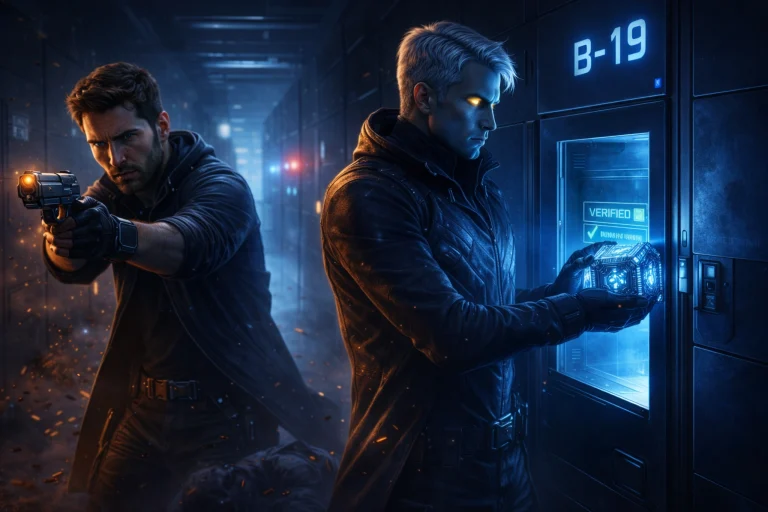
Aris had already connected the module to an isolated local layer that didn’t route through anything likely to leave traces. The last thing I wanted was for an unfamiliar device to thank us with an explosion, a virus, or a legal dispute.
Several encapsulated schematics flared above the table.
“These are not standard audio bugs,” Aris said.
“From which I conclude our night is getting even more interesting.”
“These are behavioral collectors.”
Merrow frowned.
So did I, but for a different reason. I’d worked with Aris long enough to know that when he picked a term that clean and dry, the real meaning underneath it was bad.
“Explain it to me like I’m a man with limited patience,” I said.
Aris rotated one of the schematic layers, and fragmented patterns rose above it—time intervals, pulse graphs, micro-lags, pressure maps, access routes through the house.
“Someone wanted not only to listen to Mr. Merrow,” he said. “They also wanted to model him.”
Silence settled over the room.
That particular kind of silence where rich people stop acting like they own the situation and I start suspecting our job has grown into something nobody is going to enjoy.
“More specifically?” I asked.
“These devices gathered biometric and behavioral signatures from movement, gestures, access rhythm, microvascular responses on contact surfaces, time habits, and internal route logic. They did record conversations, but that was secondary. Their primary function was to build a credible model of presence.”
I looked at Merrow.
“Someone used your house as a mold.”
He stared at me blankly for a second, then another.
“I don’t understand.”
“You understand perfectly,” I said. “The insurer claims the theft of your assets originated from your private domain, using your own signatures, in a way that looks like an inside job. But someone spent weeks here copying your habits, your reactions, your access windows. They weren’t just watching you. They were studying you.”
Merrow slowly set down the glass he had picked up.
“So you can prove I’m innocent now?”
“Not yet. Right now, all I can prove is that the man who came to remove those devices got shot before I could ask him questions. Which is generally not how calm and innocent parties behave in an insurance dispute.”
Aris opened a second layer from the core.
“There’s more.”
Of course there was.
“The module is synchronized with an external forensic model,” he said. “Not just with the theft. With the evidentiary package for the theft.”
Merrow jerked his head up.
“What does that mean?”
“It means,” I said before Aris could explain it too academically, “someone wanted not just to rob you. They wanted the version of the robbery to look stable by the time it reached the police, the insurer, and the courts.”
That hit him.
I saw the exact moment his fear moved from the zone of my money is gone into the much uglier zone of someone has arranged an entire reality against me and I may not be able to get out of it.
“Helix Indemnity,” he said dully. “They already denied the payout. They claim I drained my own reserve and am now playing the victim. Central is breathing down my neck too. They said if one more piece of evidence turns up, they’ll seek seizure of all my assets and detain me instead of just banning me from leaving the city.”
“They’re already late in their search for the right evidence,” I said.
I looked at Aris.
“Tell me you’re not thinking what I’m thinking.”
“I’m almost certainly thinking more.”
“Reassuring, as always.”
He ignored that with his usual lack of respect for good cynicism.
“There is a service signature in the modules. It passed through three shell layers, but not cleanly enough. Someone was in a hurry during the wipe. The main thread leads to an internal Helix subcontractor,” Aris said. “High-risk claims division. Less official name: Claims Integrity Response.”
Merrow went rigid.
“You’re saying my insurer put this in my house?”
“I’m saying,” Aris replied calmly, “that a device used to construct a false but credible model of presence carries residual traces from infrastructure that also handled your denied claim.”
“Which is his very elegant way of saying your situation is appalling,” I added.
Merrow ran a hand over his face. He wasn’t a stupid man. That was exactly what made him useful and dangerous at the same time.
“Why?” he asked. “Why would they need to copy my behavior from before the robbery if I’m the one guilty of my own losses?”
Good question.
And exactly the kind of question that almost never comes with an answer that lets you sleep better.
I looked at him and didn’t soften any of it.
“Because either the sum is big enough to be worth murder and forensic substitution… or something in what was stolen is worth more than the sum itself. Which of the two did you fail to mention?”
He went silent.
There it was. The moment when the client decides whether he wants to remain a client or become a problem.
“Mr. Merrow,” Aris said quietly, “this would be a good time to stop optimizing the truth.”
I hated it when he was right in that tone. Unfortunately, it happened often.
Merrow exhaled slowly.
“Not all the assets were mine,” he said at last. “Part of the package was a temporary consortium buffer. Parked with me for a short period. Not entirely officially.”
“Wonderful,” I said. “So you’re not just a rich trader with bad luck. You’re a rich trader with bad luck and other people’s money in the wrong kind of shelter.”
“It wasn’t a shelter. It was a protected reserve package.”
“That distinction only matters to people no one has tried to kill tonight.”
Aris pulled another data layer closer. This time what appeared above the table weren’t addresses, but protocol lines marked with time tags, internal maintenance markers, and a purge queue.
“Here is what I don’t like,” he said. “The police have most likely already received the convenient version. Something that looks clean enough to pass through their normal internal process.”
“What does that mean?” Merrow asked.
“It means what we’re looking for is not the public face of the fraud. We’re looking for the back room where they washed their hands after it. Illegally collected raw data is not kept in official archives. It’s kept briefly—long enough to train, verify, and align the false model with the real logs. Then it’s purged.”
Merrow went even paler.
“So the thing that could clear me…”
“…is exactly the thing they’ll try to destroy first,” Aris finished calmly.
I liked that less than I would’ve liked not learning it at all.
Merrow stared at the lines above the table as if enough force of will might make them less true.
“Can anything be done?”
Aris didn’t answer right away. I never liked that pause.
“We can try to find the buffer before they wipe it,” he said at last. “But this is no longer the same case you hired us for.”
I looked at Merrow.
“So far, you were paying for a bug sweep and a check on whether someone was setting you up for a convenient denial. From here on out we’re talking about penetration, data extraction, and stepping under the swinging hands of an insurance company that obviously prefers its witnesses permanently silent.”
He was quiet for a few seconds.
“How much?” he asked at last.
That was a good sign. Desperate people sometimes argue. People who are truly frightened ask the price first.
“The remainder of the original contract,” I said, “plus three times that on top. Up front. And this time, no optimized versions of the truth.”
Merrow clenched his jaw for a moment. Then he nodded.
“Agreed.”
“Wise,” I said. “Because the alternative is Helix washing its hands while Central puts cuffs on you with a clear conscience.”
Right then another dry window opened above the table. Legal. Ugly. Ordered with that administrative confidence that had always irritated me, because it’s most dangerous precisely when it’s wrong.
EMERGENCY DETENTION PREP
CENTRAL FINANCIAL CRIMES
SUBJECT: CASSIAN MERROW
STATUS: PENDING EXECUTION WINDOW
I looked at it.
“Central do not appear inclined to send you a basket of apologies.”
Then at Aris.
“And Helix?”
“Helix is preparing to purge the raw material and leave behind only a sufficiently good official version,” he said. “If we’re late, all that will remain is the substituted truth.”
A lot of things ran through my head in a short span of time. The dead fake technician on the roof. The behavioral collectors in the walls. The size of the sum. Other people’s money in a temporary buffer. An insurer that was no longer just playing dirty, but playing in a disciplined way. And a window that was closing fast, because that’s how well-organized fraud works—not with noise, but with procedures.
I looked at Aris.
“Any way to find where they’re keeping the buffer?”
“Not a complete one,” he said. “But we do have a service marker, a residual handshake, half a route, and sufficiently bad intentions.”
I nodded once.
Then I stood up.
“Great,” I said. “So tonight we’re done hunting bugs.”
I took my weapon off the table, slipped the module back under my jacket, and looked out at the grimy hotel window, beyond which Tanarielis was glowing so beautifully you’d think the city had no interest at all in what kinds of lies it turned into bureaucratic calm.
“Tonight,” I finished, “we’re not chasing the thief. We’re chasing the cleaner.”
***
This is only the beginning of the case. Enter your email to get notified when Part 2 goes live, along with occasional behind-the-scenes notes, extra world details not published on the site, and updates on future Tanarielis stories and book releases.