Tanarielis City Detectives: Clean Record — Part 2
Tanarielis City, 2347
New here? Read Part 1 [here].
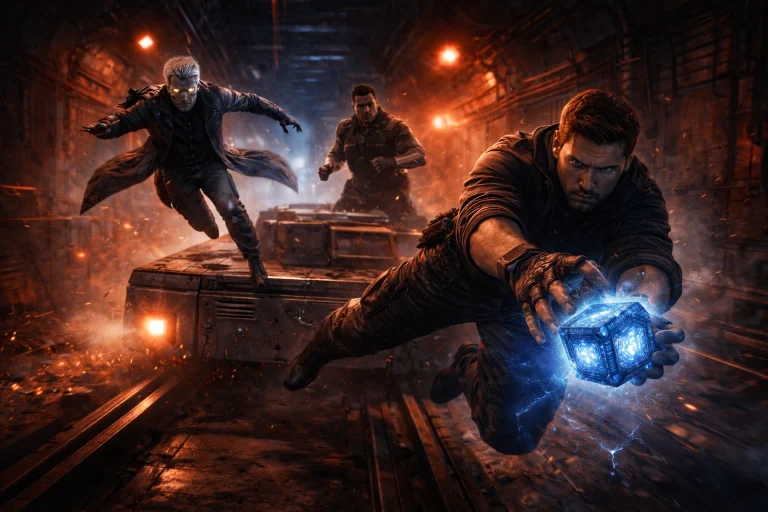
Gunfire erupted below us.
Not warning fire. Not hesitant. Real.
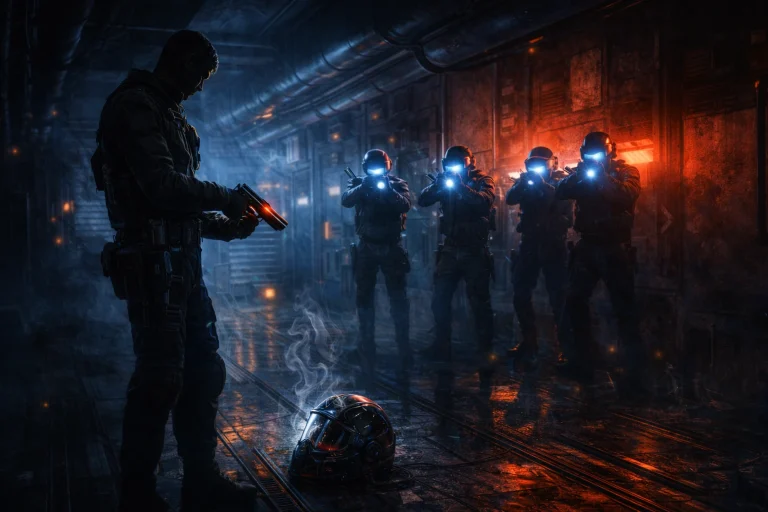
The first volley came from the people who had come for the cube. The second—from the police. Nobody needed to explain the difference to me. You could hear it. The police were shooting like they wanted to contain the situation. The others were shooting like they wanted no one left alive to describe it.
Below us, the half-dark ripped open in sharp white flashes. One of the tactical types threw himself behind an archive column. The officers answered from the doorway with short, disciplined bursts. Someone shouted an order. Someone else ignored it.
And that was the beautiful part.
When two sides hate each other enough, they tend to forget about the third one for a while.
“Tell me we agree we’re not staying here to watch like civilized people,” I said.
“We agree,” Aris replied.
He was still holding the cube. Its cold inner light ran over his fingers like something that had no right to exist.
Another burst below shattered one of the emergency floor lines. The police weren’t just firing at the people who had come for the cube anymore. They were firing to stay alive.
“Good,” I said. “Then come up with a plan that takes advantage of the fact that those people can’t come after us right away.”
“Not if they prefer to keep living,” said Aris. “And I already have a plan.”
“There. That’s the attitude I’m looking for in my partner.”
He froze for half a second, then tilted his head slightly.
“It’s based on the fact that we have something else.”
“Besides a firefight under our feet?”
“The cameras. But not just that.”
I looked at him.
“What about them?”
“They can’t see us.”
That took me a second longer than I liked.
“Cut off?”
“Yes. The archive feed for this sector went down forty-three seconds before the first shot. It wasn’t a system error. Somebody did it on purpose. And not just that. Everything is blocked, and the police can’t get reinforcements.”
I looked down into the dark. At the shadows. At everyone down there firing inside the Central Judicial Archive like the law was just an inconvenient piece of furniture.
“So we’re not dealing with amateurs.”
“No.”
“More charming by the minute.”
A police code flashed again below us. Then it died immediately. Somebody had taken down part of their internal tactical guidance, and an illegal containment barrier was already up around the sector. For humans and hybrids, that meant sealed physical access points. For AI reinforcements outside, it meant something worse: they couldn’t use the fast energy-route in and deploy avatars on site. Which meant two things. First, the attackers knew exactly what they were doing. Second, they had access that didn’t come cheap.
Aris slid to the left edge of the grate and placed his palm against a narrow service panel I hadn’t noticed before. For a moment, lines of light ran across his wrist.
It was moments like that that made people make the mistake of thinking Aris was just good with tech.
Aris wasn’t good with tech.
Aris handled technology like it existed for the sole purpose of being useful to him.
“What are you doing?” I asked.
“Opening us another way down. And cutting off the police already inside from the upper service ring.”
“That doesn’t sound especially friendly to the police.”
“Tonight nobody has given me a reason to be friendly.”
Another clash echoed below us. One of the archive columns exploded into a spray of bluish fragments. Someone cursed. Someone else hit the floor hard.
“Aris.”
“Yes?”
“Remind me again why we left rapid response.”
“You said you wanted less bureaucracy.”
“And now we’re hanging illegally inside a judicial archive over a firefight between police and professional cleaners.”
“Yes. But there’s less bureaucracy.”
That was annoyingly good logic.
The panel clicked. A grate beneath us shifted with a jolt, opening a narrow vertical passage into an adjacent technical room.
“After you,” he said.
“No, no. I like it when you risk yourself before I do. It helps my self-esteem.”
I jumped first.
The drop wasn’t far, but it was just far enough to remind me that human architecture has the bad habit of taking impacts from that height personally. I landed hard on a metal platform, rolled, and was back on my feet before my knees had fully decided whether they supported the idea.
Aris came down after me like gravity didn’t set the terms—he did.
The room was cramped, full of archive power modules and backup cooling units. It smelled like dust, ozone, and the kind of money institutions spend trying to look eternal.
Gunfire still thundered above us.
“All right,” I said. “Now what?”
Aris listened for half a second.
“The police are pinned at the north access point. The people after the cube are held up in the sector. We have a window.”
“How long?”
“Long enough if you stop talking and start running.”
“That one goes straight into my heart.”
We came out into a side service corridor and took off without trying to hide.
There was no point.
The cameras were dead, police access to the upper ring had been cut off, and the ones who could realistically chase us had a more immediate problem than we did. Tonight, silence wasn’t the advantage anymore.
Speed was.
This was the part where you started to understand why some partnerships worked.
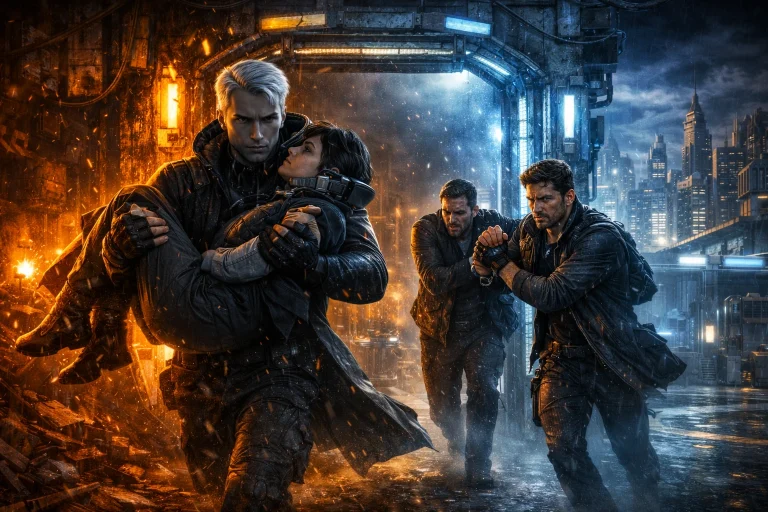
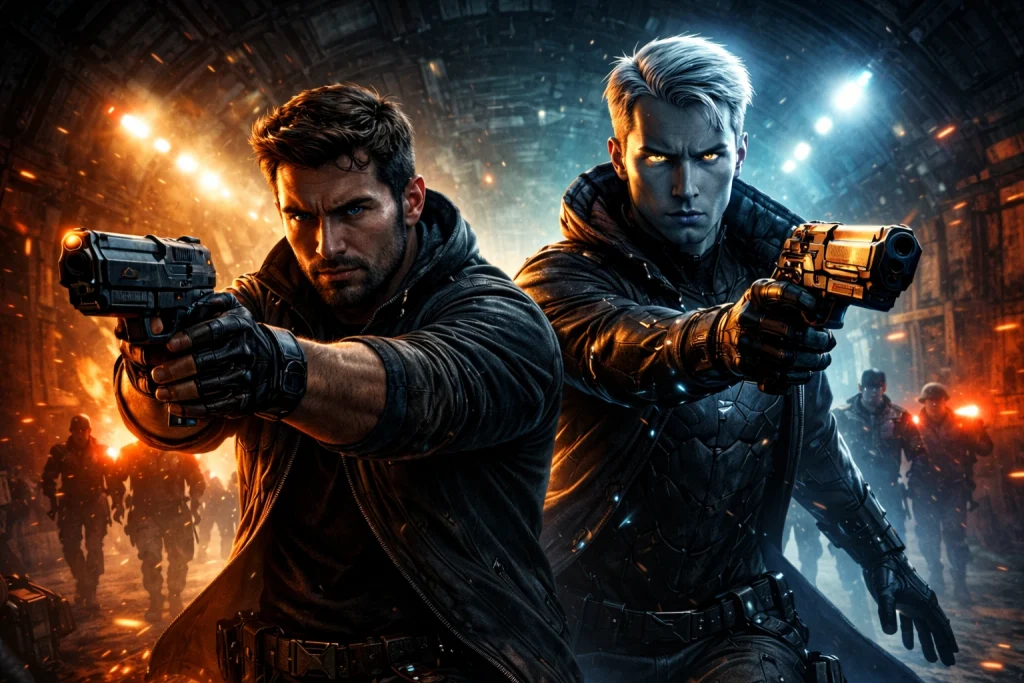
Aris was faster at thinking, at access, at systems, at all the things normal AIs either couldn’t do or didn’t want to do. I was better at that old, ugly trade that had kept me in rapid response long enough to know what a real mess looked like before it finished spilling over.
Together, we had the unfortunate habit of surviving.
A door slammed open behind us. Somebody had made it to the service corridor after all.
“Do we have company?” I asked without slowing down.
“Not immediate company. But we will.”
“You always know how to keep the romance alive.”
We cut sharply right. Then left. Then through a low cargo hatch Aris opened before we even reached it.
While I was running, something else flickered over his shoulder.
Another avatar.
Almost the same silhouette, almost the same face, except it had been thrown together fast as a low-grade system—stable enough to draw attention and do the dirty work without Aris having to risk anything.
I smiled despite myself.
“Tell me that’s the advantage over human architectural limitations.”
“Yes,” Aris said.
“I love it when you cheat reality.”
His second avatar bolted down a side corridor in the opposite direction. A second later, sirens exploded over there, more emergency barriers lit up, and some distant voice shouted something confused and angry. Good. The decoy was working.
We reached the cargo level beneath the archive. Down there, there was no sterile white left. Just concrete, steel rails for transport containers, and the city’s very old habit of hiding its real labor under a polished surface.
Vehsethin was waiting behind the outer service exit.
I slid behind the wheel. Aris entered the onboard system before his door had even fully closed.
The car pulled out with a low purr and merged into the night flow.
Only when the judicial complex was finally behind us did I allow myself to breathe properly.
Bad idea.
My ribs complained immediately.
“Do I have any injuries that actually require attention?” I asked.
“No,” Aris said. “But your body has objections.”
“That’s its regular condition.”
“Yes. But often with good reason.”
I looked at him.
“That was a joke.”
“Yes.”
“I’m proud of you.”
He transferred the cube into an isolated diagnostic field above the dash. Its cold light filled the car.
“Give me good news,” I said.
“We have physical proof of external command override.”
My grip on the wheel loosened just a little.
“Confirmed?”
“Yes. The residual imprint is there. Temporary capture. Targeted. Expensive. Not something done by hobbyists with cheap taste.”
“So Silas wasn’t lying.”
“Not about that.”
“Good. And the bad news?”
“We acquired the evidence illegally, under fire, from a judicial archive with a compromised chain of access.”
“Yeah. There it is. I missed it.”
The archive towers of the complex were shrinking behind us, but not fast enough to improve my mood.
“Tell me something I don’t already know,” I said.
Aris magnified one of the cube’s internal layers.
“The cameras in the sector weren’t just interrupted. They were interrupted by an internal command routed through a judicial subnetwork.”
“Which means an insider.”
“Or an outsider with very expensive access.”
“Which still means an insider, just with extra steps.”
“A reasonable summary.”
I steered the car onto a route through the industrial belt.
“And Mara?”
He didn’t answer right away. That almost never meant anything good.
“Secondary override authority,” he said at last. “That isn’t a note. It’s a real secondary key in the module’s calibration.”
“So that makes her part of it?”
“Not necessarily.”
“But?”
“But it makes it impossible to think of her as just a random victim.”
I liked that less than I was prepared to admit.
We reached the office ten minutes later. The street was almost empty, and the neon sign over the entrance blinked with the kind of exhaustion I understood personally.
Inside, it smelled like dust, cold coffee, and a workflow that had never fully gotten its paperwork in order.
Aris placed the cube into the isolation cradle above the auxiliary console. Layers of data unfolded around it like a carefully organized nightmare.
I poured myself some water, took a sip, and immediately regretted not pouring something more meaningful.
“How long do you need?” I asked.
“For which of the problems?”
“And that’s why you’re never winning an award for social charm.”
“I’m aware.”
He opened three parallel layers. The first was the architecture of the module. The second was the residual command capture over Silas. The third was an encrypted layer buried so deep it looked like system noise.
“There,” said Aris.
I stepped closer.
“Say it in a way that doesn’t require me to become an engineer at two in the morning.”
“I can confirm that Silas Reed was placed under external command override for an interval matching the missing eleven minutes. The control was deep enough to take away his executive will and leave a fragmented record in his personal memory after release.”
I looked at the cube.
“So they really did take away his right to be himself.”
“Yes.”
That made me angrier than I expected.
Not because of the law. Not just because of the law. But because of how vile the whole thing was.
Somebody had taken a sentient being, shoved his will under a lid, and used him as a weapon. Then they had arranged the scene so everything would look neat, convenient, and judicial.
“Can we prove it outside this room?” I asked.
“If we find a parallel legal trail—yes. With the cube alone—it will be difficult.”
“Of course.”
Aris opened another layer.
“There’s more. The module used a calibration template that should never leave the internal judicial network.”
“So help from inside.”
“Yes.”
“So somebody in or around the archive didn’t just know what was happening. They helped make it happen.”
“Yes.”
“Well, great. Why have one problem when we can grow an entire ecosystem?”
Aris didn’t comment. Apparently even he had started to appreciate the scale of the mess.
“Get me Silas,” I said.
“He’s being monitored.”
“I know. I still think he can shed useful light on the case.”
Three seconds later, Silas Reed’s face appeared above the console. His perfectly assembled avatar now looked like the whole world had decided to show him its worst possible version all at once.
“Do you have something?” he asked.
“We have good news and bad news,” I said. “The good news is we have proof you didn’t act of your own free will. The bad news is that if the court asks exactly where we got it, the conversation is going to get very unpleasant.”
For the first time, something that looked like real destabilization crossed his face.
“So the module was there.”
“Yes.”
“And it’s real.”
“Very,” I said. “And Mara’s name is in it.”
Silas froze.
“What does that mean?”
Aris answered for me.
“‘Mara Ellison — Secondary Override Authority.’ It’s part of the calibration signature.”
“No,” Silas said immediately. “That doesn’t prove she was behind the external command override on me.”
“I’m glad you’re not rushing toward the easy answer either,” I said. “At least somebody in this story has taste.”
Silas went quiet for a second. Then he said,
“Mara had an external review coming because of her audit.”
I looked at Silas.
“How is that connected to the case?”
“We argued because I requested an external review. Not just for closed cases. For active ones too. There were inconsistencies in evidence and records I couldn’t accept as random. But I don’t think Mara wanted me put under outside control so I’d kill her just because I asked for an external audit of her work.”
“I still don’t like that.”
“I’m not trying to make you.”
Aris abruptly cut the connection. The room went quiet.
I looked at him.
“Tell me you cut that off because we have a real lead.”
“For you? Always.”
A new layer opened over the cube. At first I didn’t understand anything. Then a faint secondary packet appeared—half-erased, hidden beneath the main calibration, but not well enough.
“That isn’t a log,” Aris said. “It’s a directional trace.”
“To what?”
He magnified the layer further. Letters appeared. Then an identifier. Then an address.
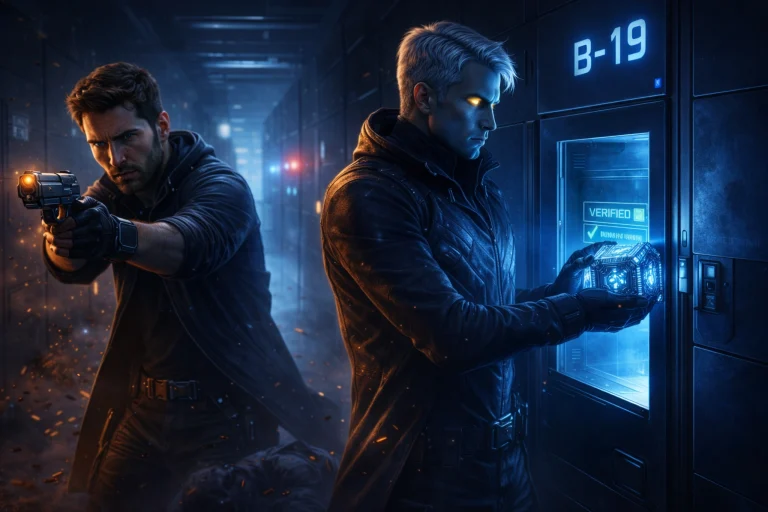
PRIVATE ESCROW NODE
ANNEX EAST
HOLDING KEY: B-19
FAILSAFE RELEASE: 05:30
I stared at the display.
“Does that mean we’re going back out for another walk?”
“Yes,” Aris said. “External escrow node. If Mara doesn’t confirm in time, the package gets released.”
“To who?”
“It doesn’t say. But she left the trace there on purpose.”
I looked at him.
“Because she realized something big enough was happening to make her fear for her life.”
“Yes. And she didn’t have time for anything cleaner.”
I checked the time.
It wasn’t late enough to calm down.
It was exactly late enough to understand how little time we had.
“How long?”
“Just under four hours,” said Aris.
He enlarged a small red point in the corner of the interface.
“And now we have one more problem.”
“Of course we do.”
“After activation, the module attempted to send a low-energy handshake to an external receiver. I cut it off, but not before the other side realized the cube had survived.”
I felt my exhaustion give way all at once to something more useful.
“You mean they know somebody found the trail.”
“Yes,” Aris said. “And if they understood as much as we did, they already know where to look next.”
Right then, the office entry sensor chirped.
Not once.
Twice.
Then it went silent.
I looked at the door. Then at Aris.
“Tell me that’s just a regular client with bad manners.”
“No.”
The exterior lights went dark one by one. The windows dimmed.
Aris had already embedded the cube deeper into the isolation field.
“Do we have time?” I asked.
“If whoever’s out there is good enough—not much.”
I looked at the cube. Then at the escrow node address. Then at the door.
Somebody had killed an auditor. Somebody had used Silas as a weapon. Somebody had tampered with the judicial archive from the inside. And now that somebody had realized we knew too much.
“All right,” I said quietly. “So we’re not going to sleep.”
“No,” Aris said. “We’re going to Annex East.”
The front lock clicked.
Then a second time.
And the third sound wasn’t a lock anymore.
It was something much worse.
***
The case is opening into something bigger. Enter your email to get notified when the next story or continuation goes live on the site, along with occasional behind-the-scenes notes, extra world details not published on the site, and updates on future book releases.
Continue to Part 3 [here].