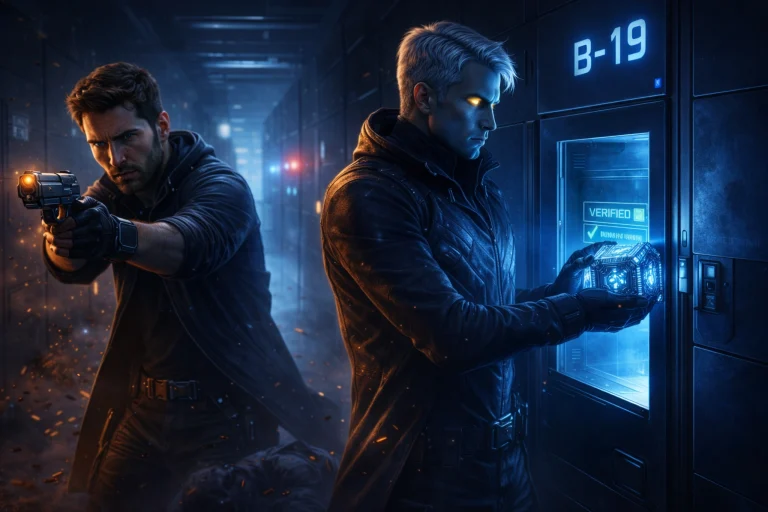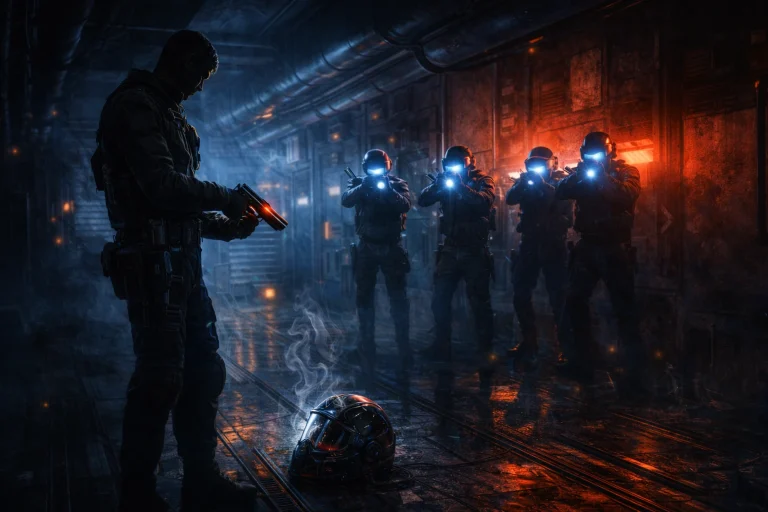
Tanarielis City Detectives: The Beginning – Part 1
In the Line of Duty | Parallel World: Darknet 2336
The first shot wasn’t aimed at me.
That was the most annoying part of the whole thing.
Not in the sense that I’ve got some fragile ego and need bullets to show me personal respect. It’s just that when the shot isn’t meant for you, but for something above your head, it usually means somebody wants to bring half the structure down and kill you with architecture. And in Darknet, architecture already had a habit of collapsing now and then without anyone shooting at it.
The metal grate above the passage howled, tore loose on one side, and came crashing down with all the worn-out malice this place could muster. I threw myself forward, slid across the greasy floor, and felt the edge pass inches over my back. Behind me, the lights burst into bluish sprays, then the corridor sank into half-darkness and dirty red emergency light.
“I’m looking for Luis!” I shouted. “If hiding is your local standard for hospitality, you should know I come from better neighborhoods, where being afraid of guests is considered rude.”
Somewhere to the right, someone laughed.
Not that light laugh people make when they’ve won. The worse kind. The laugh of someone who’s convinced you’re funny because you’re already dead and just haven’t realized it yet.
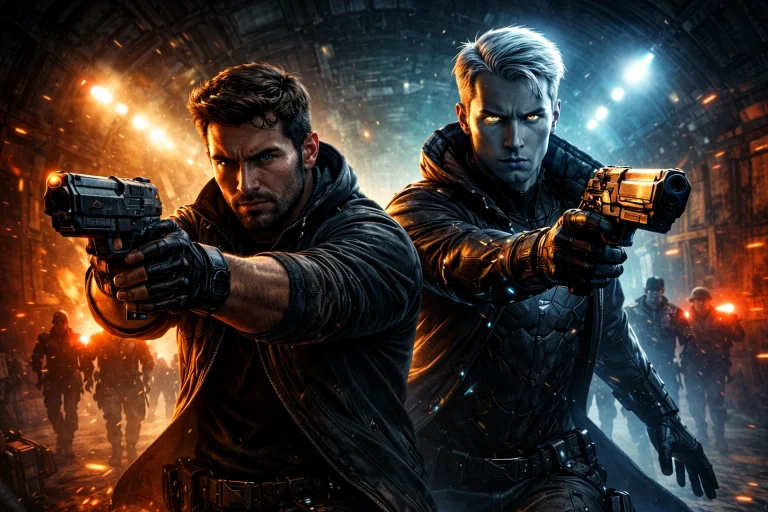
I pressed myself against the wall and raised my weapon.
The answer was a short automatic burst.
I had half a second to assess the situation before my body assessed it for me. Three shots slammed into the metal shell of an abandoned service module, spraying sparks and the stink of burned insulation. The fourth passed way too close to my face. The fifth never reached me at all, because someone killed the lights in the entire corridor.
Total darkness.
Then, out of the dark, came a calm voice.
“If you’re planning to die tonight, at least do it quietly. You’re distracting me.”
I recognized the voice.
“That’s very kind of you, Virus. I was just starting to think you’d moved out of here too.”
“It’s not kind. It’s practical. Get down.”
I got down.
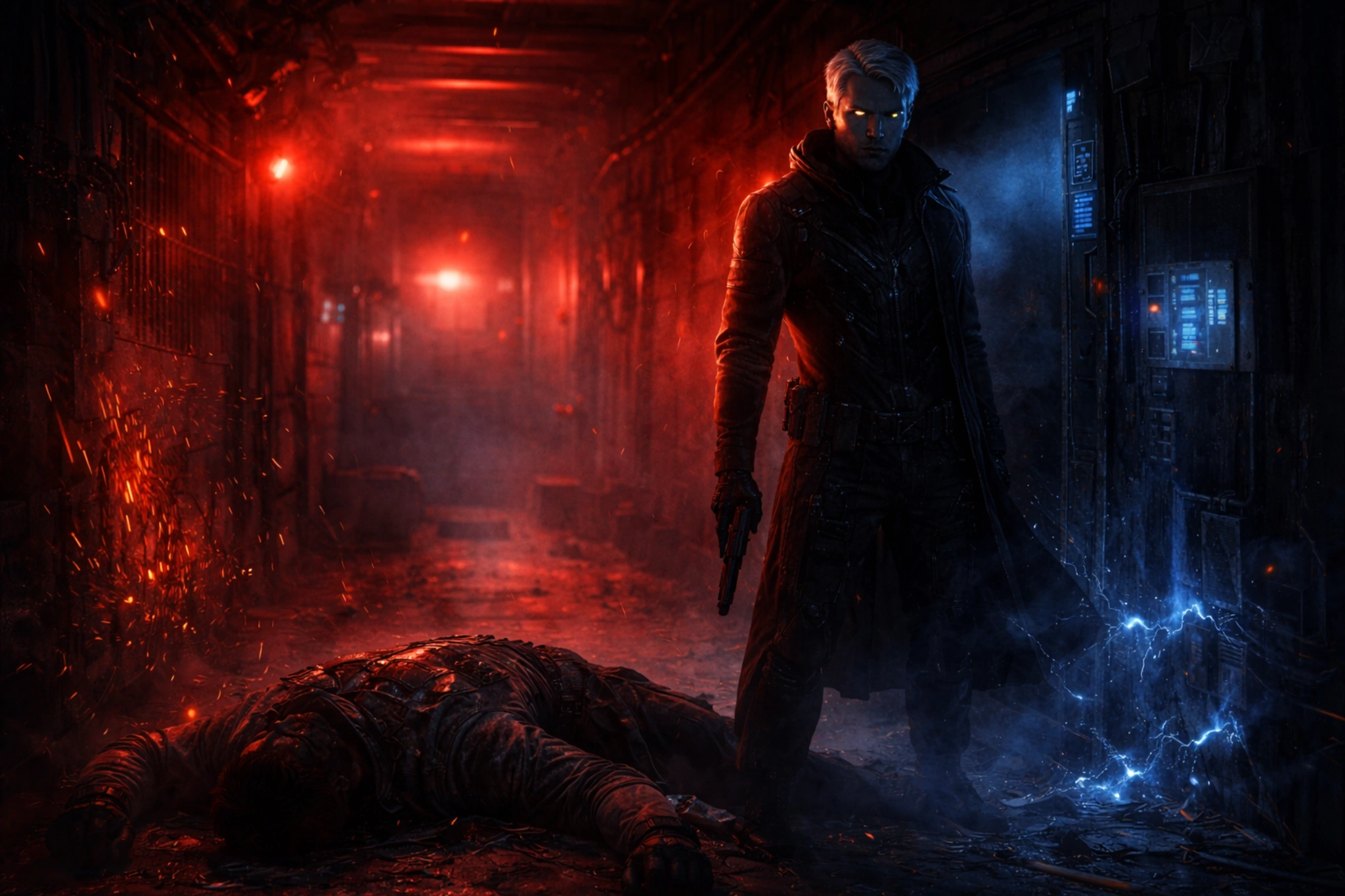
Two things happened at once. First, somewhere ahead of us, a short electromagnetic pulse went off and somebody’s targeting system crackled one last time. Second, in the dark, a thin line of cold light flashed, followed by the sound of impact into something soft, then something hard, then somebody’s groan cut off halfway through.
When the backup lighting flickered back on, one shooter was already lying face down by the wall, one arm twisted at the wrong angle. The second was trying to raise his weapon, but it wasn’t responding. Virus stood beside him.
“Stood” wasn’t exactly the right word.
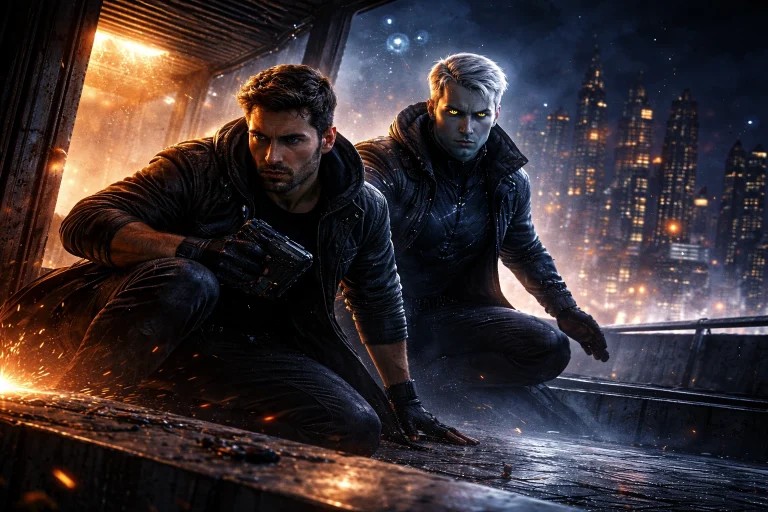
His avatar was humanoid, young, and lean, almost irritatingly calm against the filth around us, but he moved with that kind of economy that doesn’t belong to humans. He didn’t waste motion. He didn’t waste force. He just placed himself wherever he could cause the other guy the most trouble.
He grabbed the rifle barrel, twisted it aside, kicked the shooter’s knee, and in the same motion drove his other hand into the port behind the man’s ear. There was a short crackle—something between a hack and a personal insult—and the man dropped.
“Two of Luis’s puppets, ready to kill for him,” Virus said, in a tone that made it clear he considered me a less-than-brilliant conversational partner. “They don’t know where he is. You’ve got about a minute before somebody decides it’s a good idea to send more.”
I got to my feet.
“You said you were selling me a route to Luis, not a small war.”
“In Darknet, that’s the same thing.”
I looked at the two men on the floor, then back at him.
“How many people does Luis Vorn have in this sector?”
Virus tilted his head as if the question amused him.
“Enough.”
“And why are you still here?”
“Because you refused to pay me all of it up front, like I asked. So you still owe me. I agreed that you had a point—dead men don’t pay. But don’t get too attached to your theory.”
Unfortunately, that was a fair answer.
I’d gotten to him through the kind of bad, quiet recommendation that gets passed around among people who used to work on one side of the law and now live too close to its edge. Nobody had told me to trust him. They’d only told me that for my money, I wouldn’t find a decent guide through Darknet who wouldn’t sell me out before midnight. But Virus might be worth the risk. He needed money, didn’t have many clients, and was good at hacking, digging up information, and fighting. In the context of the place, that almost counted as a moral recommendation.
“Fine,” I said. “Lead the way.”
“That’s a different service now.”
“Then charge me for it, but don’t get too ambitious with the pricing.”
Virus looked at me for a second. Then he smiled a little—not pleasantly, but like a creature that had reached the conclusion that I was slightly less useless than I looked.
“I’m starting to like you, cop.”
“I’m not a cop.”
“Of course you’re not. There are no cops here. You’re alone.”
That landed closer to the target than I liked.
My partner had been dead for sixteen days.
Not that I was counting. Counting was for people who believed time did something useful. In all that time, all I’d managed to acquire was a crime scene photo, three locked reports, a disciplinary note on my service profile reading temporarily suspended from field operations, the name of the man who had fatally shot my partner and escaped through an illegal channel into Darknet before Zurvanius could seal the perimeter, and a one-way ticket to follow him. Luis Vorn. Part of an armed crew specializing in hits on transit financial hubs. On paper, a bank robber. In practice, a well-trained predator with bad habits and even worse employers.
That robbery of his left me without a dear friend and colleague. I wanted, at the very least, to be able to tell his wife that justice had been done and that her husband hadn’t been murdered without consequences for the man who did it.
That was why I was there.
Not for procedure. Not for the badge. But to drag Luis back to Tanarielis in handcuffs—breathing if possible, hauled if necessary. The court could take care of the rest.
Virus led me through a side corridor so narrow that in two places I had to turn sideways to get through. The walls were covered in cables, old markings, and new stains from things I preferred not to identify. Somewhere far below us, heavy infrastructure was running—a low, constant rumble, like the heart of a machine that didn’t care who it was keeping alive.
“Luis isn’t operating alone,” I said quietly.
“No one here who likes to think of themselves as smart operates alone.”
“Is his crew planning more hits soon?”
“I don’t know.”
“You’re lying.”
“Of course.”
He glanced back over his shoulder.
“But I lie selectively. My information costs money.”
We came out into a junction that had probably once been a technical hub and now looked like the kind of place where humans, hybrids, and AIs went to buy a weapon, an organ, a replacement part, or whatever version of the truth suited them best. Two burned-out signs hung above us, a hand-mounted neon strip flickered to the left, and on the right a vendor with a mechanical jaw was arguing with a customer over the price of a modified sight. Farther on, a hybrid boy with an artificial iris and blinking light-filaments under his skin was unloading crates from a handcart, while beside him a narrow, faceless service avatar was negotiating with two people for supposedly safe access to the more dangerous lower channels. Darknet had never belonged to just one kind of crime. That was exactly what made it so dangerous.
Virus stopped short.
“Don’t look left.”
“Why?”
“Because the guy by the water machine just sent a signal that you’re here.”
I looked left.
“Of course you did,” Virus said. “You humans are emotionally attached to bad decisions.”
The man by the machine was already drawing a weapon.
I shot first.
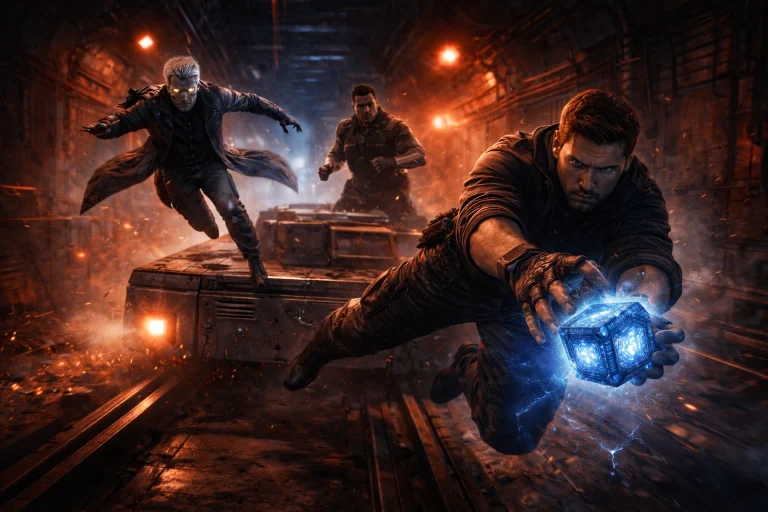
He threw himself backward, knocked over the machine, and sent water splashing across the floor. A second shooter answered from the platform above us. His shot shattered the neon, and the darkness turned colorful with sparks. I heard Virus say something softly—not to me, but to the system around us. One of the doors on the left snapped open, the other locked, and a narrow service platform slid sideways, cutting off the upper shooter’s line of sight.
“Now!” Virus said.
I ran.
The first attacker was still on one knee when I reached him. I knocked his gun downward, drove him upward, and for a fraction of a second I saw that look in his eyes—the one people get when they realize they picked the wrong person for an easy victim. Then my knee went into his ribs, and he stayed on the floor.
Up above, the platform screeched.
The upper shooter didn’t fall. His weapon did.
Virus was already there. I didn’t see how he got up. One moment he was below, and the next he was up on the edge of the platform, one hand at the man’s throat and the other buried in the service panel behind him. Red warning symbols erupted across the wall, then everything went dark.
The attacker went still, as if someone had shut off not just his weapon but also his desire to participate in the evening any further.
Virus jumped down lightly, without sounding like an AI whose avatar had mass. He walked over to me and looked at my sleeve.
“You’re bleeding.”
I looked. It was a scratch.
“Don’t be dramatic.”
“I’m never dramatic. I just appreciate precision.”
I scanned the space around us. The hub was already waking up in that peculiar way a place in Darknet does when it realizes something interesting is happening and starts selling that information to whoever needs it.
“Do you have a lead on Luis?” I said.
For the first time that night, Virus hesitated. Not much. Just enough for me to notice.
“I have a probability.”
“That’s not an answer.”
“In Darknet, a lot of things aren’t.”
He started walking without saying where he was going, or why that way.
I followed him.
We reached a lower sector where the air smelled of dampness, ozone, and cheap cleaning agents—that specific smell of places where things aren’t disinfected, just temporarily persuaded not to kill anyone. A man in work coveralls was asleep on a bench against the wall, across from him a hybrid woman with metal inlays at her temples was waiting her turn with an empty injector in her hand, and at the far end two cheap, featureless avatars stood motionless like patient shadows of some more distant consciousness. Virus slowed in front of a narrow alcove where a woman sat behind transparent boxes arranged on a metal table. She didn’t acknowledge me. But she looked at him.
He handed her something—a credit chip, almost certainly. She gave him a small sealed packet with no label.
“That doesn’t look like a lead to a bank robber,” I said.
“Not everything is about you, Adrian.”
It was the first time he had called me by name.
I didn’t ask how he knew it. In my life, that no longer made the top ten list of unpleasant things.
“We need to disappear for a few hours,” he said. “Either way, you’re done with Luis for today. You need rest, and you need to take care of that scratch before it gets infected. There aren’t doctors here like there are in Tanarielis, and I’d be left unpaid.”
“I didn’t come to Darknet for a vacation, and I don’t have anywhere to go.”
“Pay me and come spend the night at my place.”
I looked at him.
“You just took me through half a sector full of humans, hybrids, and AIs who either want to kill me or sell me, and now you’re offering hospitality?”
“I didn’t say it was hospitable. I said it was somewhere to spend the night. And it costs money.”
Of course it did.
The basement turned out to be under an old repair block on the edge of a service zone where even the noise of Darknet sounded tired. If someone had told me an AI with access to half the dangerous routes in the sector lived there, I’d have assumed they were joking.
Virus unlocked three mechanical locks and one electronic one that sounded like it had never seen legal software in its life. Inside there was a narrow hallway, an improvised workstation, two chairs, a folding table, and several car parts of questionable origin thrown around with the kind of orderliness that gives away an avatar forced to make the best of very little space.
“There,” he said. “The luxury of the southern underdistrict.”
“I expected less sarcasm.”
“Then you came to the wrong world.”
I took off my jacket, sat down in the chair, and for the first time in hours allowed myself not to look at every doorway as a potential problem.
Virus set the packet from the market on the counter, opened a metal cabinet, and pulled out a tool kit, spare cells, two energy modules, and a box of rounds, which he put away.
“All right,” I said. “Can you tell me what you know about Luis now? I did pay you for information.”
“I know he doesn’t sleep in the same place twice.”
“I already knew that.”
“I know he works for a crew that doesn’t use their real names in the channels.”
“That’s so typical it goes without saying.”
“I know that if you pressure him the wrong way, he’ll burn his routes and disappear even deeper.”
“Quit stringing me along! I’m not as bad as you think I am! Tell me what I don’t know.”
Virus shut the cabinet.
“That tomorrow I might tell you. If you pay me.”
He liked holding information like a knife. Not to use it right away—just to remind you he had it.
I was already about to tell him exactly what I thought of that work style when I heard the sound.
It wasn’t loud. That was the worse part. A quiet, broken sound—something between a choked breath and an attempt not to bother anyone.
I looked toward the inner door at the back.
Virus froze.
For the first time since I’d seen him, something happened in his face that wasn’t controlled. Not fear, exactly. Closer to that moment when something too personal gets dragged into the light and you don’t have time to put your armor on.
“Who’s in there?” I asked.
“No one.”
A second sound came from inside. Then the light knock of metal on concrete.
I stood up.
“Adrian, go back to where you were,” Virus said quietly.
“If you’re going to shoot me, do it fast and say goodbye to the payment you’re expecting.”
“Don’t act like an idiot. I know you owe me money.”
“If you’re not going to shoot me, then I want to know who else is here besides you.”
I moved toward the door. He was beside me in less than a second.
He didn’t hit me. He didn’t draw a weapon. He just stepped into my path with that kind of stillness that says the next move will be a mistake for both of us.
“It’s none of your business,” he said.
“I’m already in your basement. It’s a little late for that line.”
Something clattered again inside.
Virus closed his eyes for half a second. Then he stepped aside.
“She’s not a threat to you. See for yourself, then get out of her room. But understand this—if you make even one wrong move in her direction, I’ll still shoot you, even if you do owe me money.”
He opened the door.
The room was even smaller than the rest of the place. It had a low bed, two old medical modules pieced together from incompatible parts, a pile of cables, a filtration membrane running on sheer faith, and a girl no older than twelve or thirteen curled on her side under a thin thermal blanket.
A hybrid.
Something was wrong with her. Her left arm was human, but along the wrist fine pulses of light moved through it, unstable and broken. Under the skin of her neck, a faint technological circuit flickered in a way that didn’t look right. One of her eyes was closed, the other half-open, with an unfocused shine.
A metal cup lay on the floor beside the bed.
I realized the girl couldn’t control her body well and had dropped it twice.
She lifted her head slowly. Saw me. Then looked at Virus.
“I didn’t mean to interrupt you,” she whispered.
Her voice was hoarse, but calm in the way children speak when they’ve learned to measure exactly how much pain they can admit to without burdening the person across from them.
Something in my chest tightened.
“You’ve seen she’s no danger to you. Now get out of her room,” Virus whispered to me. He clearly no longer counted me as a threat to the girl, because he demonstratively turned his back on me and went to her.
He took the packet from the market, knelt by the bed, and opened it with movements that were too fast to be truly calm.
“You’ve got a high fever again, Emma,” he said to her. “How long?”
“Not long.”
“With you, ‘not long’ is a terrible unit of measurement.”
She tried to smile. Didn’t get very far.
“Did you manage to buy the more expensive medicine?”
Virus didn’t answer.
That told me enough.
He took out an ampoule of cloudy silver liquid. Clearly it wasn’t the expensive medicine, and around here you never really knew what you were buying or how closely it matched anyone’s definition of medicine. There was no one to monitor quality, or ingredients.
“What’s wrong with her?” I asked.
Virus looked at me like the question was an invitation to war.
Then the girl said quietly, “Bad luck.”
“I still don’t understand,” I said, giving up a little.
Virus placed the injector with practiced precision and waited. The pulses of light under her skin shuddered, went out of rhythm, then slowly began to settle.
“She’s my sister,” he said without looking at me. “Half-sister. Her sync is breaking down. It means her system can’t decide what to listen to—the biology or the AI layer fused with her body at the cellular level.”
The room went quiet.
Not the comfortable kind of silence where people give each other space. The other kind. The kind that happens when someone has just set the most dangerous thing they own down on the table between you.
“And your parents?” I asked.
“We don’t have any,” Virus said.
I nodded slightly.
I understood enough now.
The girl started breathing more evenly. Virus adjusted her blanket with movements that didn’t resemble anything else I’d seen from him that night. They weren’t softer. They were more careful. That was what mattered.
That was exactly when my communicator vibrated.
I pulled it out almost automatically. The one-line message was from Virus, who had just broken his own rule about never doing free favors for me.
VORN LEAVES THE SECTOR AT DAWN. OLD FREIGHT CORRIDOR 9. ONE CHANCE ONLY. — Virus
I looked up.
Virus was still by the bed. His sister had closed her eyes. The empty ampoule lay near his hand, and in his gaze there was, for the first time that night, something that couldn’t be hacked, bought, or calculated.
He was looking at his sister in a way I hadn’t expected him to be capable of.
I looked at his message. Then at him.
And that was when I realized that besides catching my partner’s killer, I also wanted to figure out how to help the AI I’d hired to find him.
***
Darknet doesn’t let go easily. Enter your email to get notified when the next story or continuation goes live on the site, along with occasional behind-the-scenes notes, extra world details not published on the site, and updates on future book releases.
Continue to Part 2 [here].