Tanarielis City Detectives: Clean Record — Part 3
Tanarielis City, 2347
New here? Start with Part 1 [here] or continue with Part 2 [here].
The front lock clicked.
Then a second time.
And the third sound was no longer a lock.
It was a cutting tool biting into the metal doorframe, leaving behind the smell of heated alloy and very bad intentions.
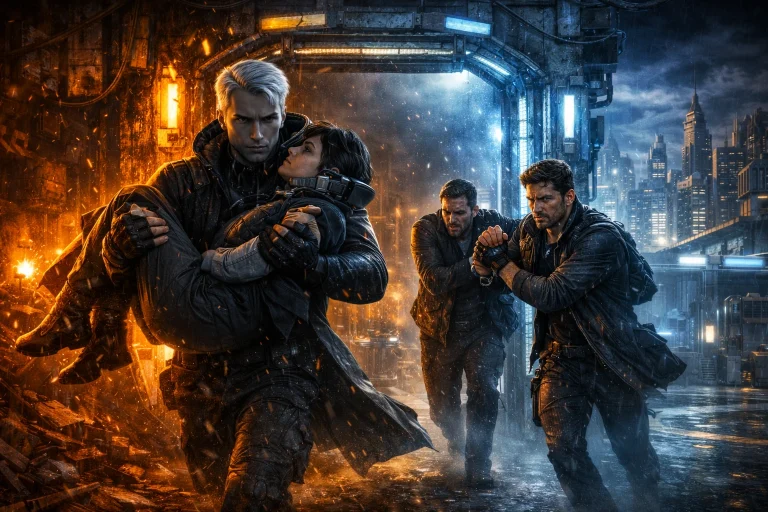
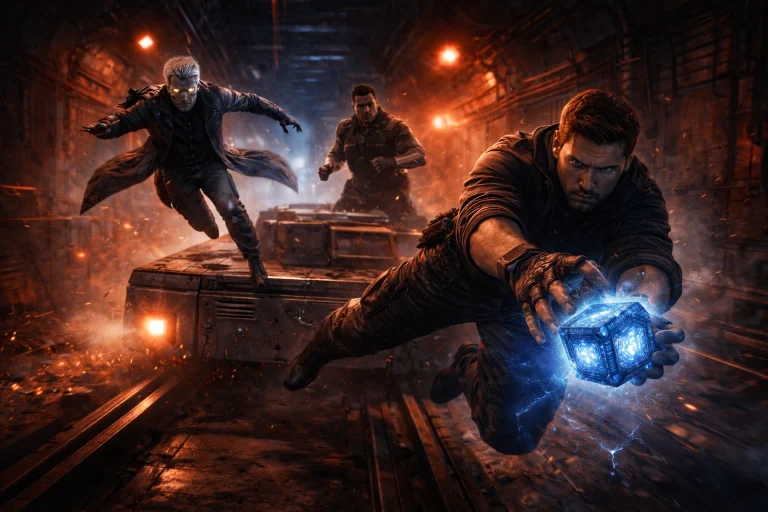
Aris deployed a second avatar in the corner of the office—solid and armed enough to prove to anyone outside that more trouble was waiting inside than they had planned for.
“We’ve got about two minutes to get out before the door gives up,” Aris said.
“Are these the good kind of two minutes, or the kind with an unpleasant aftertaste?”
“That depends on whether you use them well.”
I took in the room in a glance. The door. The windows. The console. The cube, sealed inside its isolation field like a small cold heart at the center of this whole mess.
The door was going to give any second.
“Aris.”
“Yes?”
“We need a plan that doesn’t include death, prison, or long explanations to administration.”
“I can offer a plan for two out of the three.”
“Surprisingly generous.”
He was already killing the interior lights and opening the rear service exit onto the narrow stairwell we only used when trouble had started taking an uncomfortably active interest in us.
The door groaned and began to give.
I didn’t wait to see what came next.
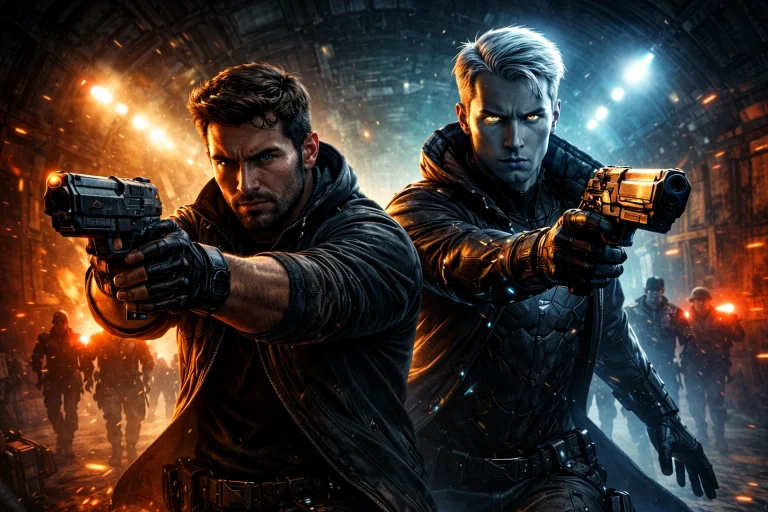
I grabbed my weapon and headed for the back door. Aris’s second avatar stayed by the console. He raised his pistol with that cold composure that always made me wonder whether somewhere deep in his code he had accepted chaos as a personal aesthetic.
“Tell me that’s not a sacrifice,” I said.
“It isn’t. It’s an investment.”
Something cracked outside. Then the front door gave way.
We went down the stairwell in semidarkness while gunfire erupted behind us in the office.
It didn’t last long.
It never lasts long when somebody expects an easy entry and finds Aris on the inside with all the upgrades on his avatars that I never ask where he bought.
By the time we reached the lower level, I had heard only three things: a short burst, an angry shout, and a metallic impact, as if somebody had learned the hard way that the door wasn’t the most dangerous thing in the room.
“Did your second avatar survive?” I asked.
“Yes.”
“And the others?”
“Less so.”
“That’s my favorite kind of report.”
We stepped out into the back alley, where Vehsethin was already waiting with quiet mode active and both doors open. Aris wasn’t just prepared. Sometimes I had the feeling that if he decided to, he could organize my escape before I’d even figured out I needed one.
I slid behind the wheel. He entered the car’s system at the same time as two exterior sensors and a street traffic node, without bothering to inform me of any of the details.
“Annex East?” I asked.
“Yes.”
“Do we have a tail?”
“Not yet. But they know we’re no longer at the office, and they know where we’re going.”
“So the night is staying in character.”
Vehsethin shot forward and merged into the night flow. Tanarielis was glowing the way it always did—beautiful, shameless, and completely indifferent to the fact that somewhere inside it, humans, hybrids, and AIs were trying not to die while the institutions pretended everything was still within the bounds of order.
“Tell me we have a chance of getting there first,” I said.
“I wouldn’t say that,” Aris replied. “But we do have a chance of getting there in time.”
“That’s my favorite kind of optimism from you. It offers no hope, but at least it doesn’t waste time.”
The node address hung above the dashboard, cold and brief as a sentence:
PRIVATE ESCROW NODE
ANNEX EAST
HOLDING KEY: B-19
FAILSAFE RELEASE: 05:30
We blew through two yellow lights and one in that beautiful shade of we got a ticket, but at least we’re still alive. The industrial belt opened ahead of us in concrete, pipes, cargo ramps, and administrative buildings nobody ever photographed for tourism campaigns.
Annex East stood exactly the way I imagined a place built to store dirty truths under a respectable name would stand—low facade, dark windows, discreet entrances, and the self-assured presence of a public vault where nobody asks the right questions.
We parked in the shadow of a service entrance. No patrol cars. No random pedestrians either. Which, in my experience, never meant anything good.
“Tell me we’re first,” I said.
Aris didn’t take his eyes off the data.
“We’re not.”
“What kind of company do we have?”
“Three inside. One human. One hybrid. One AI avatar. No police.”
“I’m not surprised by the lack of police.”
“There’s also a fourth signal outside. Perimeter observation. Probably for retreat.”
I looked at the building.
“Small fish confident enough to think they won’t run into anybody above their level tonight?”
“Yes.”
“That’s good. Because I don’t think Silas is paying us enough for the risks we’re taking on this case.”
Aris opened a side map of the building above the dashboard.
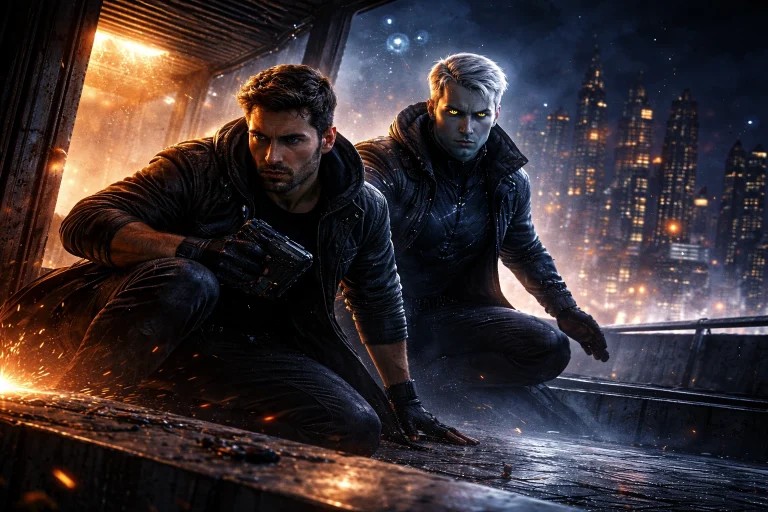
“The main access is compromised. They’re already inside the escrow sector. I suggest we surprise them through the service route.”
“The service route sounds like the correct option for us.”
We got out and slipped toward the side entrance. The door wasn’t locked. Which didn’t reassure me at all. It only meant somebody had already come through and had no reason to hide the fact.
Inside, the vault was quiet in that administrative way that had always made me suspicious of architects. Pale lighting. Cold air. Ordered lines on the floor. Discreet signs on the walls promising order to people accustomed to abusing it.
Aris raised a hand and stopped for a moment.
“They’re on the lower level,” he said quietly. “They’re not at B-19 yet. The external key isn’t enough.”
“Because they also need the holding code from the cube.”
“Or something good enough to imitate it.”
“So we’re still in the game.”
“For now.”
We slipped down the service stairs. On the next level we could already hear muted voices. One human. One rougher one—the hybrid. The third said nothing. It just gave off that steady presence that tells you an AI avatar was built for work, not charm.
“I like the quiet one,” I whispered. “The quiet ones are usually the most honest about their intentions.”
“Yes. His intention right now is to break the locker.”
“Perfect. Then let’s not let him.”
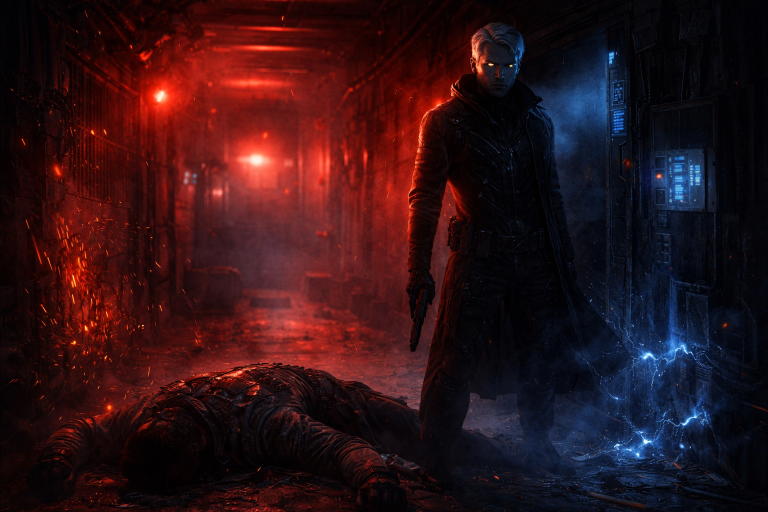
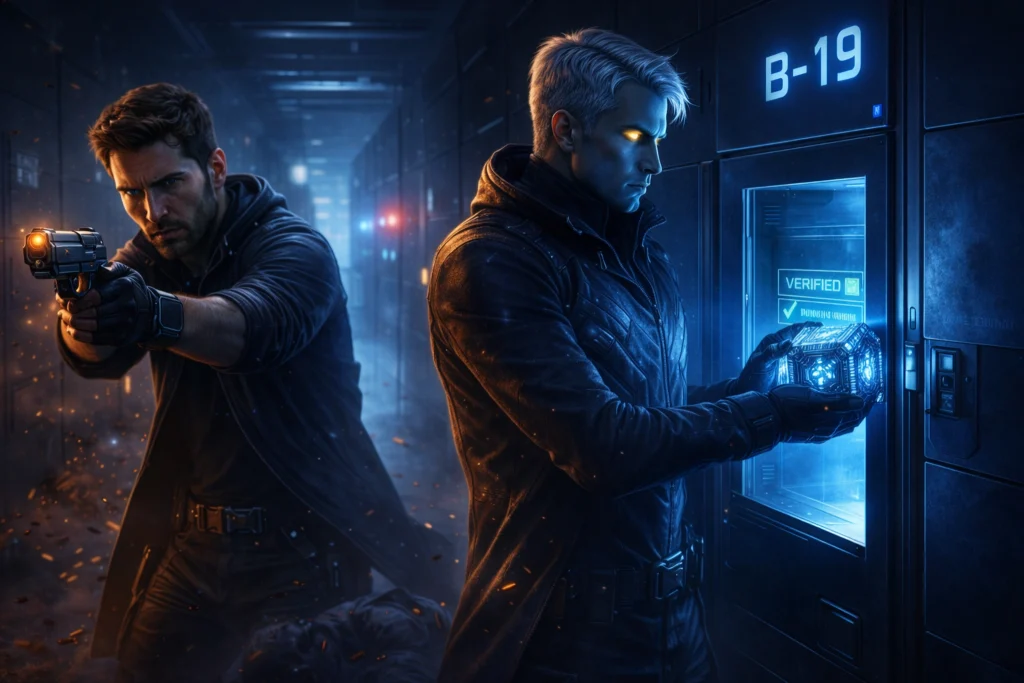
Locker B-19 was built into the back wall of a long corridor lined with protected niches. In front of it stood a low portable forced-access station, wired into the local terminal. The human was working the interface. The hybrid was covering the flank with a weapon. The AI avatar was kneeling by the floor panel doing something that was almost certainly going to ruin my mood.
“What’s he doing?” I asked.
“He’s trying to isolate the node from the external release route,” Aris said. “If he succeeds, the package won’t go anywhere. It’ll stay locked in here.”
“And then it gets erased?”
“With enough time, yes.”
“Well, good. Let’s not allow that.”
Aris went silent for half a second.
“I can make this game more entertaining.”
“That’s the most romantic thing anyone’s said to me all night.”
He didn’t object. That was a worrying sign.
We moved.
I shot the access station. The panel burst into sparks and the interface died. The hybrid brought his weapon up at me, but Aris had already sent a local pulse through the floor line. His knees folded with a short, not especially dignified sound.
The human threw himself backward toward the locker. Wrong choice. I hit the hand holding the backup decryptor, and he dropped it. The AI avatar came up fast and moved toward the left-side terminal, trying to transfer the operation to a backup channel.
“Aris!”
“Already on it.”
The terminal died under his hand. Then lit again, this time with a harsh red message:
ACCESS DENIED
The AI avatar said nothing. He just turned toward us, and for a moment I saw in his face that particular calm professionals get when they realize the plan has failed but haven’t yet given up on violence.
“At least this one is consistent,” I said.
He came at me fast. Not like a human. Like something that had calculated the angles and seen no obstacles worth respecting.
It should have. It took me less than a second to activate my armor and strip away the advantages he thought he had. I hit him sideways and turned him into the metal edge of the niche. Then I left him to spend the next few seconds reassessing his own supposed invulnerability while I cuffed him out of old habit. The hybrid and the human had already met the same fate—one after Aris stepped in, the other after my own hit. That’s exactly why I love working together.
Aris was already at the locker. His gaze was fixed on empty space beside the wall.
“Before I continue, I need you to identify yourself, then confirm that the crime report I sent to Central has been received. I expect an official record confirming the legality of our actions, as well as authorization to proceed,” he said. “For the convenience of the humans present, I suggest you use an avatar.”
An instant later, a police avatar appeared near the wall with a cold look and flawless professional composure.
“Senior Investigating Officer Daniel Ian. I confirm that I am present here in an official capacity after Central received and processed the report of a crime in this building, and the record is being prepared. I confirm the legality of the actions taken. You are authorized to proceed.”
B-19 glowed with calm blue light, as if it weren’t the reason half my night was unraveling into expensive problems. Aris placed his hand on the panel. In his other hand he still held the cube inside its portable isolation shell.
He pressed the shell against the locker port. For a moment nothing happened.
Then the blue light changed.
A short message appeared on the screen:
HOLDING KEY VERIFIED
FAILSAFE WINDOW ACTIVE
MANUAL RELEASE AVAILABLE
Aris opened the locker.
Inside there was only a small physical carrier, hand-sealed, and a secondary module for automatic external dispatch. Mara had thought fast. Not beautifully. Not theatrically. Just efficiently enough to give the truth a chance.
Aris linked the carrier to the local terminal.
First came logs. Then audit trails. Then a list of cases—not just closed ones, but active ones still awaiting review. There were differences between what had been submitted and what had been stored. Corrections. Replaced blocks. Missing evidentiary attachments. Altered timestamps.
And under all of that—a recording.
Mara Ellison appeared above the terminal.
She looked tired. Angry. And just frightened enough to make anyone understand that she wasn’t recording this out of paranoia, but out of necessity.
“If you’re watching this,” she said, “then I am no longer able to confirm that I’m safe—or alive. In that case, treat the following as a full statement.”
The AI officer stepped closer with the coolness of someone not easily surprised by statements.
“My name is Mara Ellison, senior auditor at the Central Judicial Archive of Tanarielis. In recent months, I assisted in a limited way in the manipulation of evidence and archive records in sensitive cases, at the request of outside clients. Not only closed cases. Active ones awaiting review as well. At first, it was presented to me as controlled intervention in corporate conflicts and financial disputes. It was well paid, and I had large debts to cover. That was a mistake.”
Aris said nothing. In his case, that meant a lot.
“Later, I realized a capacity was being built for much deeper intervention,” Mara continued. “The removal of political opponents through cases built on false evidence. And the acquittal of guilty high-ranking individuals. Once I understood that, I refused to keep cooperating and started gathering whatever evidence I could. I also know of the existence of an illegal external command override module. I allowed my secondary rights to be used in connection with it without managing to understand what they were actually preparing.”
The AI officer allowed himself the smallest shift. Good. Somebody was finally appreciating the weight of the case.
“I’m leaving this package, along with the evidence I gathered, outside the internal system because the system itself is compromised,” Mara said. “If I am declared a random victim, do not accept that. And one more thing. Today I argued with my colleague Silas, who requested an external independent review of my work. I assume that puts him in danger as well.”
That was enough for me.
Not because it was beautiful. But because it was true.
“With this package I am including logs, hashes, access routes, and a record of the secondary authorizations used around the module,” Mara concluded. “That is enough to trace the chain, request an independent judicial review, and break the network.”
The recording ended.
For a moment, no one said anything.
Then Aris looked at the data and said in that dry tone of his that always annoyed me when he was right:
“This is now a legal trail.”
“Say it again, slower this time, so I can enjoy it.”
The sirens outside grew louder.
This time the police units were coming in on a report already confirmed by Officer Daniel Ian.
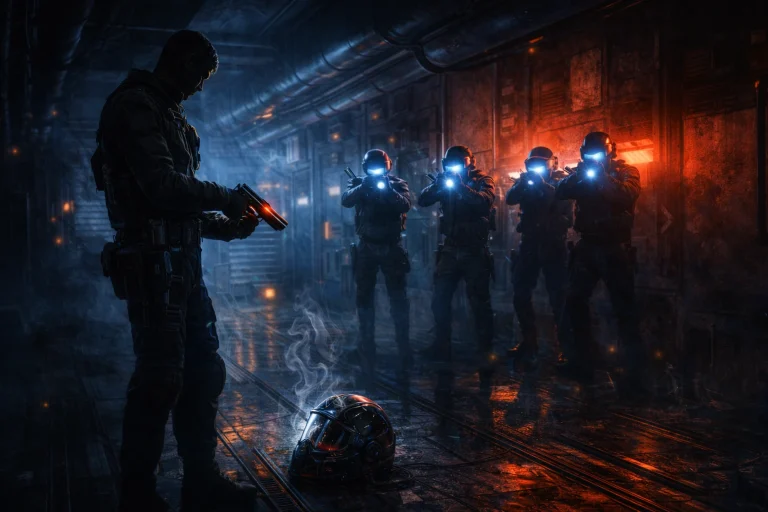
The outer doors of the annex slammed open. Seconds later, three groups entered the sector—a human, a hybrid, and two AI avatars in police bodies, each clearly marked and carrying the kind of discipline that doesn’t come from contract work.
“Hands up!” the first officer shouted.
Nobody had any desire to argue with that.
Not Aris. Not me.
I raised my hands a little more slowly than police manuals probably prefer.
“Tonight, I’d just like to point out that once again, you arrived after the good part.”
One of the AI avatars looked at me the way someone reviews a memo they already dislike on principle.
The other looked at the active terminal, the released package, and Mara’s still-open log.
“I confirm externally certified release,” he said. “The package is already in the independent registry.”
“Beautiful,” I muttered.
The police detained the three cleaners without much ceremony. None of them seemed especially talkative. Which suited me fine. Big schemes rarely depend on people who explain everything at exactly the right moment.
And I didn’t need a face at the top.
Tonight, it was enough for me that the scheme was real, that Silas had been used, and that the chain could no longer be shoved back into the dark.
By the time we got back to the office, dawn was breaking. The office looked awful. I went searching for a surviving cup. I needed to pour myself something. And this time, I was going to try not to make it water.
Tanarielis always looked most innocent at that hour. That had always irritated me.
Aris went straight into the consoles without wasting time and opened the external registries. Mara’s package had already spread far enough to become irreversible.
“Give me good news,” I said.
“Silas Reed is no longer the primary suspect.”
“That’s a start.”
“There is now an order suspending the internal proceedings against him pending independent review of the case.”
I leaned back.
“All right. That’s something.”
“There’s also bad news.”
“This bad-news thing is becoming a habit with you.”
He showed me the incoming message.
Licensing Commission.
I opened it. Read the first line. Then the second. Then stopped being surprised, because I didn’t have the energy for that anymore.
“They want an explanation,” I said. “For unlawful entry into the Central Judicial Archive. For interference in an active police operation. And for improper handling of the cube as material evidence.”
“The wording is inaccurate,” Aris said.
“Yes. But it is very administrative.”
“Yes.”
The office went quiet for a moment. Outside, the first morning transit flow moved down the street. The city was beginning another day as if the night had cost it nothing.
The console made a soft sound.
Incoming secure channel.
Silas.
I looked at Aris. He opened the connection.
Silas Reed appeared above the console. His face was the same. Only his gaze wasn’t. It was quieter now. Heavier. Like the look of a being who knows he has been used as a weapon and still hasn’t decided exactly how to live with that.
“I saw the release,” he said.
“It’s beautiful when the system occasionally does its job after the appropriate amount of pressure,” I replied.
He was quiet for a moment.
“The case against me has been frozen,” he said then. “The independent review has been confirmed.”
“It’s not a victory. But it’s a very decent first step toward being cleared.”
Something like the shadow of a reaction crossed his face. With Silas, that already counted as emotional generosity.
He gave a single nod.
“Thank you,” he said. “Expect payment from me by the end of the day.”
This time the word wasn’t formal. It wasn’t procedural. It wasn’t even especially human in tone. It was just real.
When the channel closed, I kept looking at the empty air above the console for a while.
“So?” I asked at last.
Aris turned toward me.
“So we saved an innocent. Brought some dirt into the light. And will probably pay an administrative price for the method.”
“Which translates to?”
“That once again, we were right in a way institutions dislike.”
I smiled crookedly.
“That’s why we work so well together.”
“No. We work well together because I compensate for your architectural limitations.”
“And I give you the opportunity to develop character.”
“That is debatable.”
Outside, two drones crossed the morning sky, and their light slid over the window like a thin electrical memory.
The case was over.
Of course, only in the most optimistic sense of the word.
Because in Tanarielis, truth never arrives without a price.
And tonight, we had just received the invoice.
***
The truth made it out. Enter your email to get notified when the next story or continuation goes live on the site, along with occasional behind-the-scenes notes, extra world details not published on the site, and updates on future book releases.